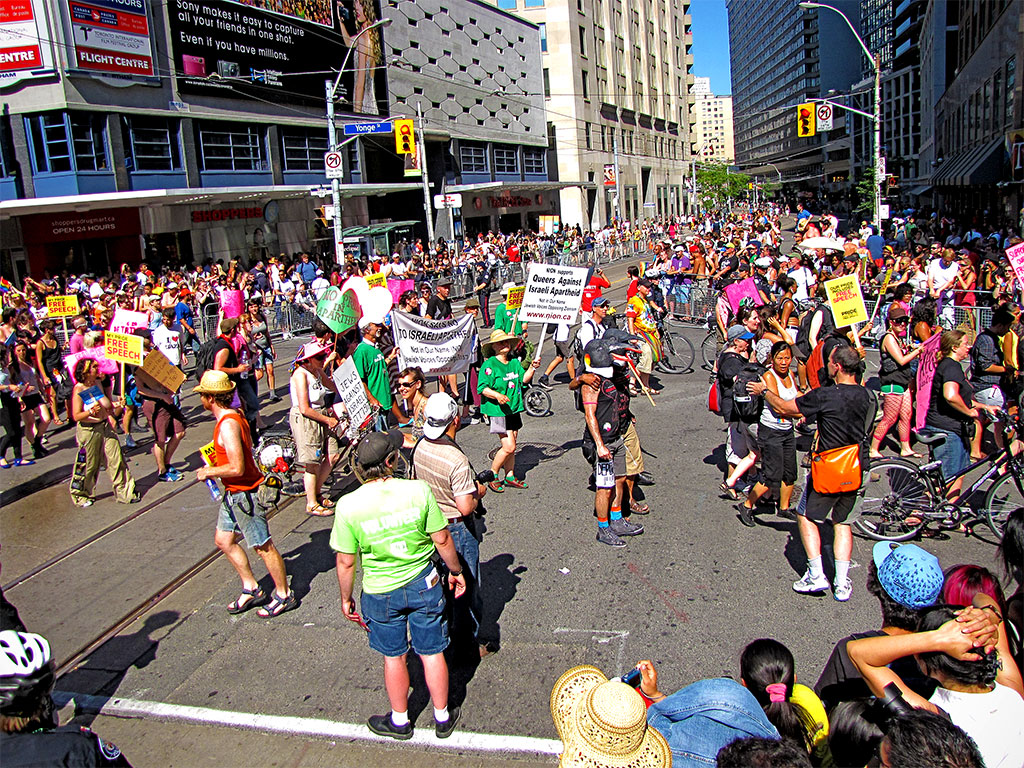
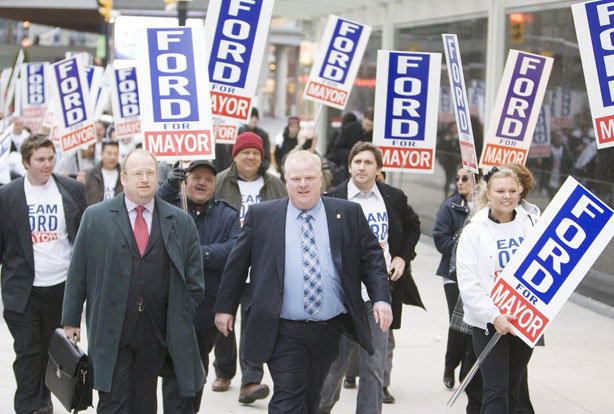
Rob Ford is a lifelong resident of Toronto. The son of a former MPP, the late Doug Ford, Rob grew up with community service in his blood. Elected in 2000 as the Councilor representing Ward 2 in North Etobicoke, Rob has become one of the hardest working councilors in the city. His focus on ensuring transparency and accountability in public spending, setting an example for excellence in customer service, and his passion for making sure tax dollars are spent on the things people and families need most has marked him as a leader on council.
Prior to being elected, Rob spent 10 years building a family business into a multi-million dollar North American enterprise serving that now employs over 200 people with locations in Etobicoke, Chicago and New Jersey. Their clients include many of North America’s largest and most recognized brands.
Rob’s passion for promoting the positive development of youth and his own experience in playing high school and university-level football was the foundation for his efforts to bring football back to high schools in Toronto. He recognized that team sports, such as football, can provide a catalyst that helps engage at-risk youth, teaches teamwork and leadership skills, and provides a positive environment for teens to develop as healthy, productive citizens. In 2002, Rob founded the highly successful Eagles football program at Don Bosco Catholic Secondary School in North Etobicoke where he remains as head coach of the Junior and Senior teams. To expand the benefit of this program to all youth in the city, Rob established the Rob Ford Football Foundation which has raised more than $100,000 to purchase equipment and establish football programs at high schools across Toronto.
Rob remains an active supporter of numerous community organizations and charities, including the Salvation Army Red Shield Appeal, Terry Fox Foundation, Heart and Stroke Foundation, Toronto Board of Trade and the Toronto West Rotary Club. Rob also donates each year to numerous charitable organizations and events.
Rob and his wife Renata live in north Etobicoke with their daughter Stephanie and son Douglas.
The elimination of the Land Transfer Tax is actually a Ford election promise, unlike his push for subways, so that part of his ongoing bluster on the subject is true. The rest, however, including his recent assurance to have it eliminated by the end of his term, has been just one long pile of growing bullkaka.
For starters, shortly before he was elected he made a speech to the Toronto Real Estate Board promising that the LTT would be completely gone by the end of 2012 … “guaranteed!”
“I can’t say we’re gonna wipe it out this year, but it might be a quarter this year, a half next year, or — you know, but we’re gonna do it piece by piece. You’re gonna see a portion of the land transfer tax, I don’t know how much right now, be gone by the end of next year,” Ford said.
Granted we’re not exactly at the end of 2012 yet but Ford is already backing down on even this revised plan (once again revealed in front of the same Toronto Real Estate Board meeting), saying that he’d like to have the process of repealing the tax started by the end of his term in 2014. And in typical Ford fashion, he wants people to “get in councillor’s faces” in order to get his way.
“Folks, you must get in the councillors’ faces,” Mr. Ford said. “As we succeed in reducing costs, we can begin to phase out that terrible land transfer tax, which I never supported and I am adamant to get rid of. I’d like to start doing that before this council term is up.”
To reiterate:
2010 – Rob Ford “guarantees” to have the LTT eliminated by 2012, maybe 2011. Blames MPs, elections for possible delays. 2011 – Rob Ford cuts back on his “guarantee”, now claiming to have the LTT reduced by about 25% in 2012. 2012 – Rob Ford completely reneges on his “guarantee”, vowing to hopefully set something in motion on the LTT by the end of 2014 (much like many of his other plans). He invites constituents to get in councillors’ faces, presumably because he blames them for his inability to gain traction on the issue.
Posted on
May 14th, 2012
–
Comments Off on RCMP G20 report, let the bullshit begin
Hard to know where to begin on the recent report by the RCMP exonerating itself (surprise surprise) of any wrongdoing during the G20 summit here in Toronto. How about responsibility, for starters. Well, you all remember the infamous kettling incident where the police just rounded up everyone walking through the street, encircled them, and kept them standing in the rain for hours? Who was responsible for that again?
“I do acknowledge the operational command decisions were being made by a Toronto police superintendant who was the operational commander at the time here in Toronto,” he said.
How very interesting, considering the RCMP report claims that they were calling the shots.
The RCMP assumed the role of security lead by authority of the G8 Summit Privileges and Immunities Order, 2010-2, and the G20 Summit Privileges and Immunities Order, 2010. These orders created the legal basis for Canada to host the Summits and, accordingly, provided the RCMP with authority pursuant to the Foreign Missions and International Organizations Act to take the lead role for security of the events.
The decision makers for the G8, in descending order, were the Executive Steering Committee, the UCC Commander, the Area Commander and the Site Commander. POUcommanders, if deployed, were given authority to make decisions with respect to the tactics and equipment to be used during time-sensitive operational situations. A similar matrix was created for the G20, but an added level of Jurisdictional Commander, e.g. the MICC Commander, appeared below Site Commander to reflect the addition of the MICC.
When asked what his [ISU’s Lead] expectations were of the UCC Commander and the TACC Commander in this situation, the ISU Lead stated that he would only expect the UCC Commander to get involved if there had been a strategic need to do so (e.g. need for additional resources). The ISU Lead was clear that the kettling was a tactical decision—that is to say, it was made by the Toronto Police Service.
The RCMP reluctantly participated in kettling protesters at the G20 riots in Toronto in 2010, under orders from the local police, even though the controversial crowd-control technique is not part of the Mounties’ playbook.
So right out of the gate we have the Toronto Police claiming to give orders to the RCMP while the RCMP claims it was in charge (a number of times), and then admitting to using tactics contrary to its own “playbook”. The a TPS tactical decision overrides the RCMP’s stated policies? And who’s in charge again?
Moreover, it is the RCMP stated policy “always” to give crowds a way out.
Then there’s the back-pedaling being done on Bill Blair’s secret law (suddenly and without warning applying it to half of downtown Toronto , even when many people directly asked, certainly made it “secret”):
Documentation provided to the Commission indicates that the Public Works Protection Act regulation was enacted in response to concerns expressed by the Toronto Police Service that officers would not be able to demand identification from those wishing to enter the area in which the Summit was taking place.
“Wishing to enter”? Funny, that’s not how it was either interpreted or enforced. In fact, the law says a few different things that don’t coincide:
Powers of guard or peace officer
3.A guard or peace officer,
(a) may require any person entering or attempting to enter any public work or any approach thereto to furnish his or her name and address, to identify himself or herself and to state the purpose for which he or she desires to enter the public work, in writing or otherwise;
(b) may search, without warrant, any person entering or attempting to enter a public work or a vehicle in the charge or under the control of any such person or which has recently been or is suspected of having been in the charge or under the control of any such person or in which any such person is a passenger; and
(c) may refuse permission to any person to enter a public work and use such force as is necessary to prevent any such person from so entering. R.S.O. 1990, c. P.55, s. 3.
There was no provision for arrest if you didn’t “show your papers” simply walking around the fence, even though that’s exactly what the cops did, even though it’s obvious that this really only applied to people wanting to get inside the “Public Works” area. There’s also a lesser-known tidbit from around that time:
The Integrated Security Unit, comprised of security bodies including the Toronto police, RCMP and OPP, were concerned that lawyers were advising radical activist groups that police have limited right to question, identify and detain individuals near the fenced secure area downtown, Mukherjee said.
Blair made the request after ISU members decided extending the powers in the act, which covers buildings including Union Station and Toronto police headquarters, to the G20 fence, he said.
“The decision makers felt that a clearer articulation of what those limits are would be useful. It was not chief Blair alone. It was the ISU,” said [Police Services Board chair] Alok Mukherjee.
How about that? The RCMP claims in their report it was Toronto Police Services alone that “expressed concern” (i.e. wanted to terrorize people on the street without warrant), yet articles from that time show the RCMP (and the OPP) were in on the push for the secret law right from the get-go.
One of the more blatant lies maintained in the RCMP report is that police acted in good faith by “pre-arresting” people before they had a chance to cause trouble at the G20:
During the lead up to the commencement of the [G20] Summit, intelligence led threat assessments will be prepared by the Joint Intelligence Group (JIG). These reports will document threat levels relating to terrorism threats and planned protest threats.
The ongoing intelligence from these reports will have an impact on the deployment of human and material resources, where the potential for confrontation between protestors and police personnel are likely to occur. G20 Operations personnel conducted Vulnerability Risk Assessments in Toronto in December 2009 of the proposed venue, airport and hotels.
All “targeting” will be based upon criminal predicate: Suspects will be determined based upon their proven willingness, capacity and intention to commit criminal acts and/or create situations that pose public safety concerns.
The RCMP conclusion:
Finding No. 8: The JIG appropriately identified and assessed criminal threats to the Summits.
These are just three examples in the report. I haven’t even read the whole thing and already I’m finding the stench of bullshit unbearable. If you’re willing to hold your nose long enough and find more “inconsistencies”, I’d love to hear from you and append them here. I’m sure it’s filled with examples of this kind of crap which the mainstream media are missing in favour of easy-to-read, highlighted admissions of failure.
Nuit Blanche is one of those events that may be getting just a bit too big for its britches. I make it a point never to head out before midnight, and this year even that might’ve been too early.
The exhibits are different every year so I like the fact that I don’t have to wander far. Despite vowing to do so every single time.
The submission process for this year ended in early December, 2010 – some artists are contacted by the curators and commissioned, some can apply for an honorarium, and there are a bunch of open slots available for people who want to do their own thing. This year they might move the application process up on the calendar. I’m tellin’ ya, it’s a behemoth!
I think it would make for an interesting documentary to see someone attempt to visit every exhibit during the overnight event. It could be called “Race through the Night” or something, and it could be part tongue-in-cheek and part busted lip. The last time I did the calculations, it should be possible if every exhibit was experienced for roughly 30 seconds. Then quick quick travel.
This is one to toast with a couple of energy drinks.
Posted on
January 3rd, 2011
–
Comments Off on The end has come! (part 1)
Those people with the end-of-the-world sandwich boards were eerily accurate now that I think of it; the end did indeed come! (this after being nigh for a whole year)
But do you notice how they never bother to mention the party that happens at the end, or how, really, the only thing that ends on New Year’s is sobriety?
I’d wanted to knock a few glasses during the countdown but my celebrations ended up being a bit more demure. Wait, no, non-existent is a lot more correct. Maybe it was the change in weather (the overcast, rainy evening), or maybe I’m just getting old, but I plunked my ass on the sofa at around nine in the evening intending to head out in a couple of hours, and I closed my eyes for just a few moments — just a few goddam moments! – and that was that.
I woke up on the first at around four-thirty in the morning with a Jersey Shore marathon doing laps in the background, Ollie spread-eagled in the middle of the living room, and everything so painfully over that there was really nothing left to do but turn it all off and get back to resting my eyes.
Yup, Toronto City Life isn’t all glamour and glitz, despite what you might read around here. And what exactly is it about, then? Why, perhaps I could start off with the first picks in a top-ten list of my fave posts from 2010, to illustrate. (Hey, everyone’s doing it!)
Definitely makes the cut because of relative ease of access, great location, great subjects, and almost guaranteed drama. I’m still a little surprised that this event isn’t more popular but I’m thanking my lucky stars at the same time — you can get just about anywhere around the track while enjoying fine beverages and meals along the way. It’s a classy sort of spectator sport in that way, and is quite a grueling workout for the commoners out there on their bicycles every year, grinding metal and bone against pavement for your amusement while you feast and imbibe. Can’t be beat!
Regent Park is a volatile place at the best of times. Just when police thought they had a hold on the violence in the area that erupted there a decade or so ago (if I’m not mistaken), it seems to be returning as of the end of 2010.
Gotta be honest, if it wasn’t for the graffiti, the place would look like a prison camp. Straight up. The buildings are squat, brutish, and not usually well cared for. Dumpsters sit prominently in front of each squat and it’s mostly nothing but pavement and brick of the same ilk in all directions.
It’s meant as the go-between place for people new to Toronto. At least, that seems to have been the idea since time immemorial. But some people are never able to make it out for one reason or another. Not sure why someone would choose to be stuck there, especially when you see the amount of hopeful / guiding / mournful / unifying / uplifting stuff that adorns neighbourhood’s walls.
And don’t mistake Regent Park as some dropping off point for criminals, although it seems to be a good place to engender some. There are people there from all over, many with kids, most just trying to do better. The city can just be a bitch sometimes.
When old Ed Mirvish died a few years ago, among the eulogizing attendees at his funeral were the mayor (plus two former mayors) of Toronto, current and former Premieres of Ontario, and the Lieutenant Governor of Ontario.
Ed was a big cheese.
That goes for every sense of the word too. When you enter into Ed’s store, the wacky tacky three-ring and block-wide circus of shopping, there’s absolutely no doubt that P.T. Barnum and Mirvish were cut from the same cloth. The amount (and I believe it’s growing), of memorabilia hanging from the walls is sometimes staggering.
My faves include old posters from the shows that Ed put on at his growing retinue of theatres, and the signed photos from the actors that appeared in them. Then there are the enlarged reproductions of Ed hob-knobbing it with the Brat Pack, the Queen of England, and famous people of all kinds – singers, actors, politicians; it just keeps going and going.
And just when you think there couldn’t possibly be more, you hit the basement where they sell very different stuff – a 19th century Thai shrine, for example; a cool $24,000. But it’s all sitting out on the floor just like the $2 socks on the level above. Come to think of it, the socks were more neatly arranged.
I still can’t believe they didn’t shoo me out of the store for whipping out my lens at every opportunity, and just for that I can continue to recommend Ed’s as a place to buy quality merchandise at cheapo prices. Those $10 blankets I bought during that visit are holding up well, and if you visit at around this time of year you might end up with a free turkey too.
Brains brains brains – brains, and more brains – brains brains brns. BRAAAAAAAINS! I brained. Brain brain brain, brain brain? Brains! I brained a brain and brains brained the brain. After that, it was all just braaaaaaains and brains brains brain brain brains.
This wasn’t a series I liked because of its brains but because of its beauty.
One of the problems of living in Toronto is winter. It sucks outside the city all the more, but it can get just as cold and frozen here as anywhere else. About now is when that period begins.
And there are the short days too. You look outside at noon and you’d think it was the middle of the frickin’ afternoon! The sun hangs low in the south so if you’re blessed with a clear day, the only place to get good lighting during an early winter sunset is by the lake.
One of the cool things about living in Toronto is what the ice and snow do the city, especially by the water. You can get an eyeful there at the right time of day (or night). It’s the scale of the thing that I enjoy; a frozen lake of that size, illuminated by a glowing sunset or piercing city lights – that’s something to see.
—
Oooh! There you have the first 5 picks of 2010. And believe me when I tell you, I agonized over every post I’d written in the past year during the selection process. I mean, just picking out 10 random posts with photos would be cheap and meaningless, right? Hehe. *nervous laugh*
Posted on
November 24th, 2010
–
Comments Off on Parade of delinquency and terror, the sequel
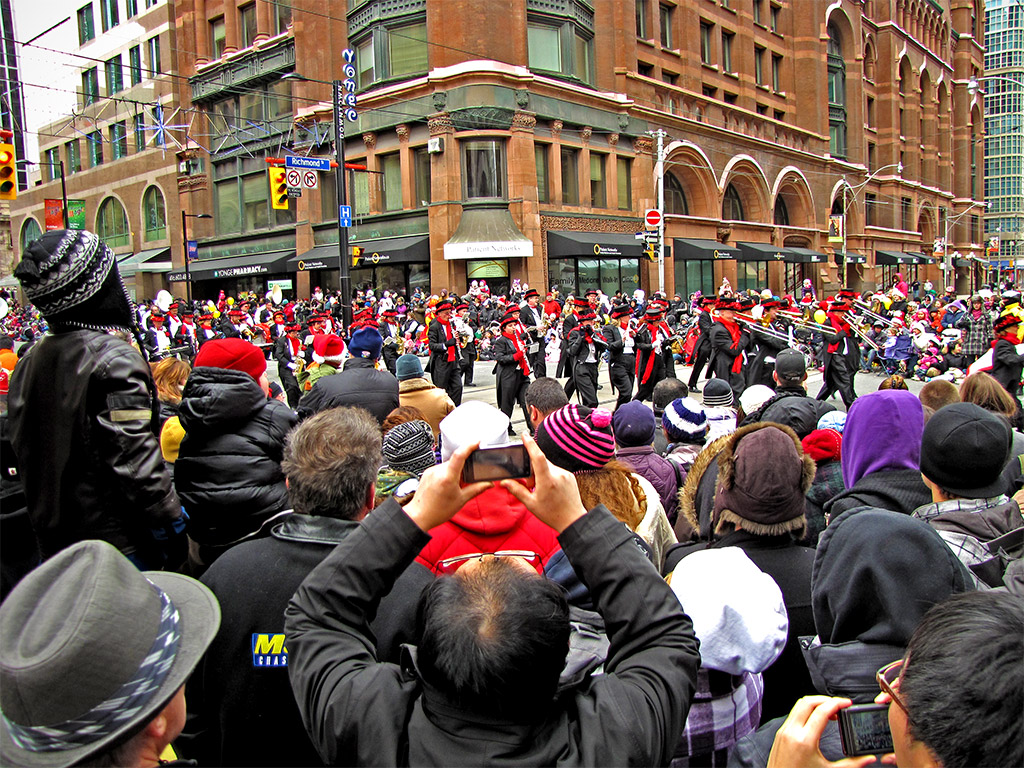
I tried to warn my sis. I referred her to last year’s experience. I told her this was no place for impressionable young kids. Did she listen? Did she do the responsible thing and not accept my invitation to the Santa Claus Parade? Am I wallowing in rhetoric just to fill up a few sentences?
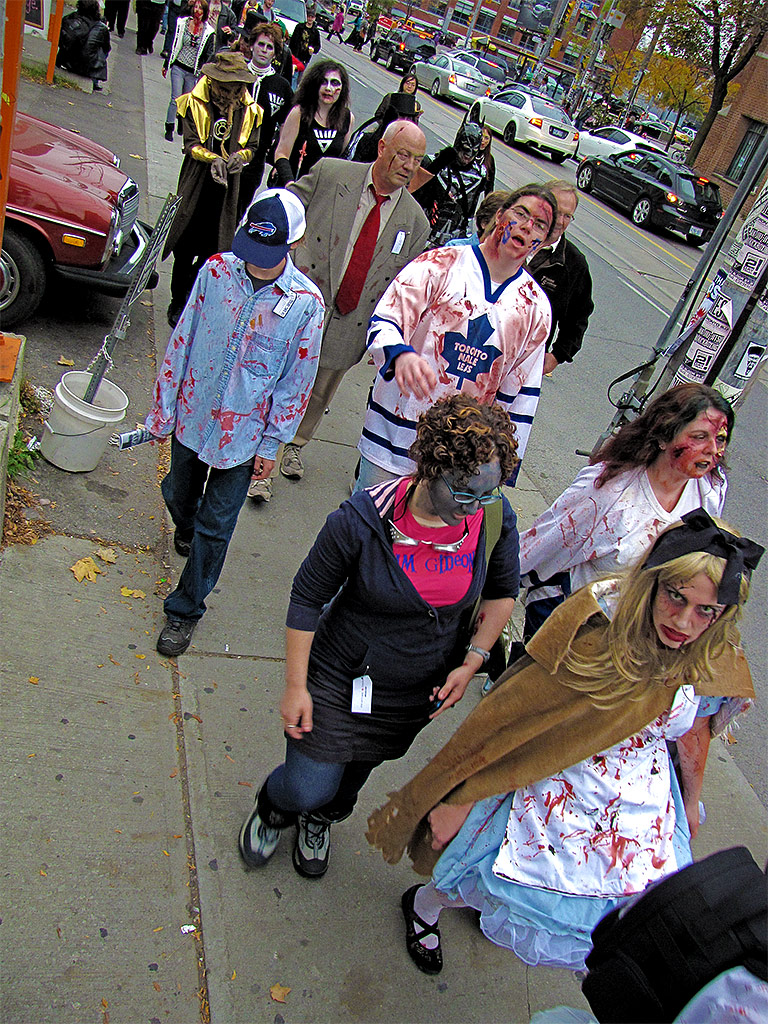
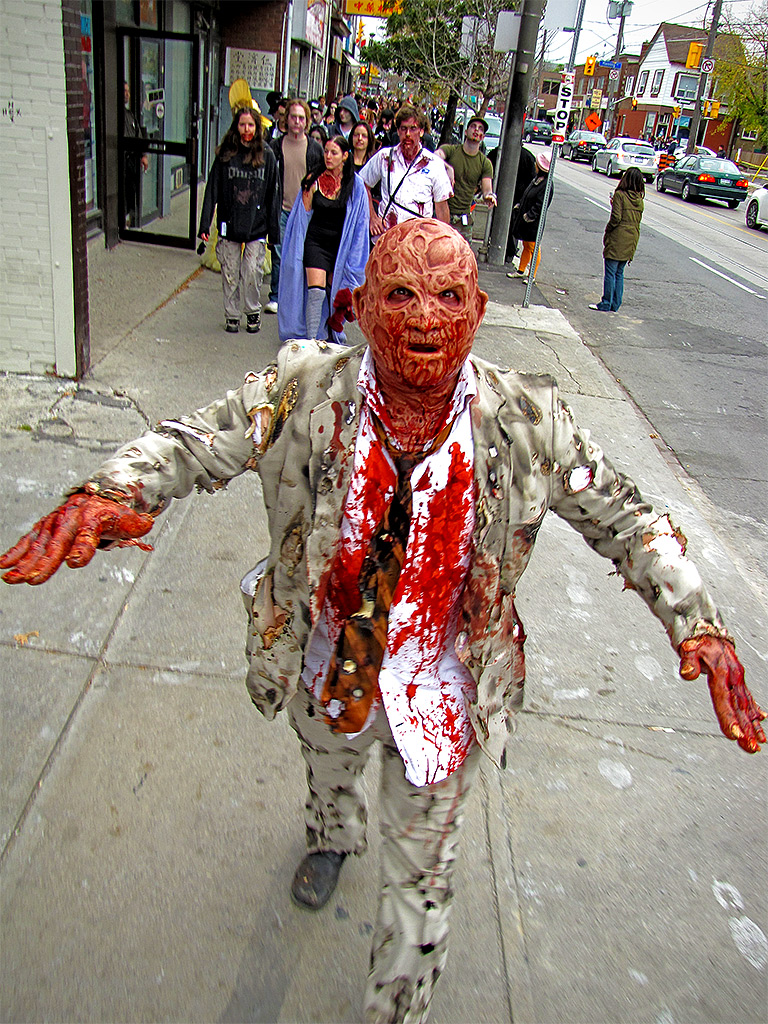
I’ve been trying to understand the appeal of zombieism — it does, after all, seem to be gaining in popularity. Is it simply a fad? Once the flakes start to fall will they just slow down and freeze, or will they have enough brains to wear parkas?
Posted on
October 24th, 2010
–
Comments Off on Zombieology 101
Heavens! Has it been a year already?
Yup, season’s fully turning now; a fantastic, cold, autumn fog is rolling over the evening city as I write this; leaves are half-shorn and fully gilded; sun’s setting at around 6, to me the most obvious time for evening to start; squirrel’s are getting pudgy; zombies are back on Toronto streets.
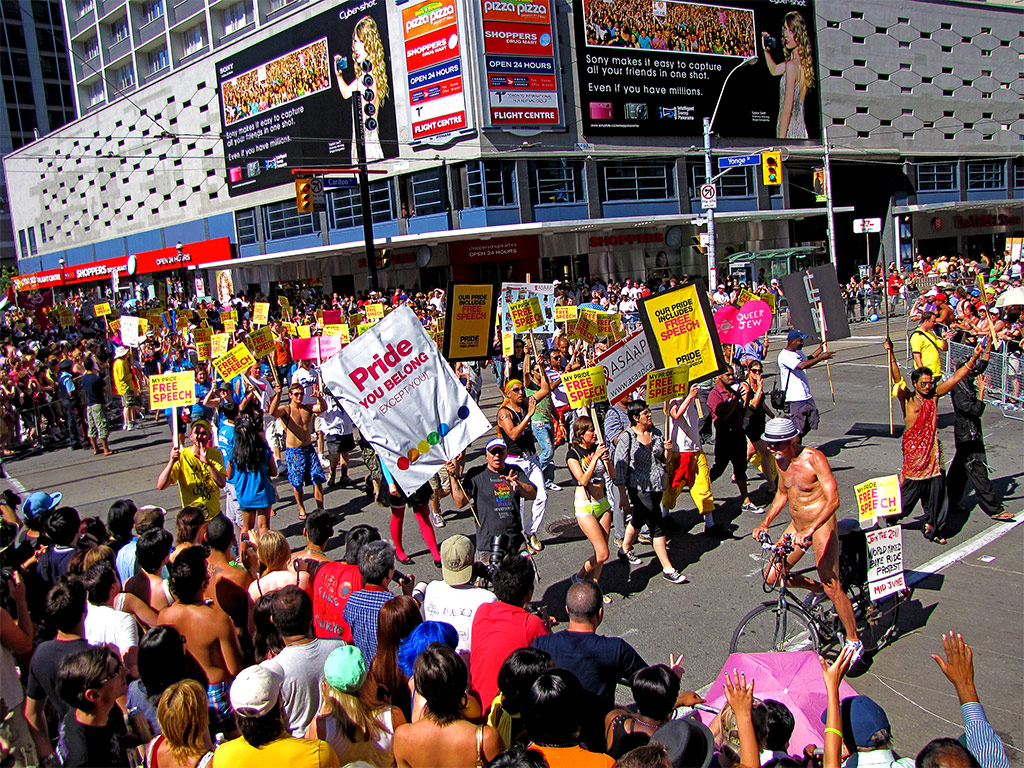
Of course there was nudity again this year. Just more seemingly painful nudity. But I’ll let you be the judge. First try to find it. Then try not to cringe.
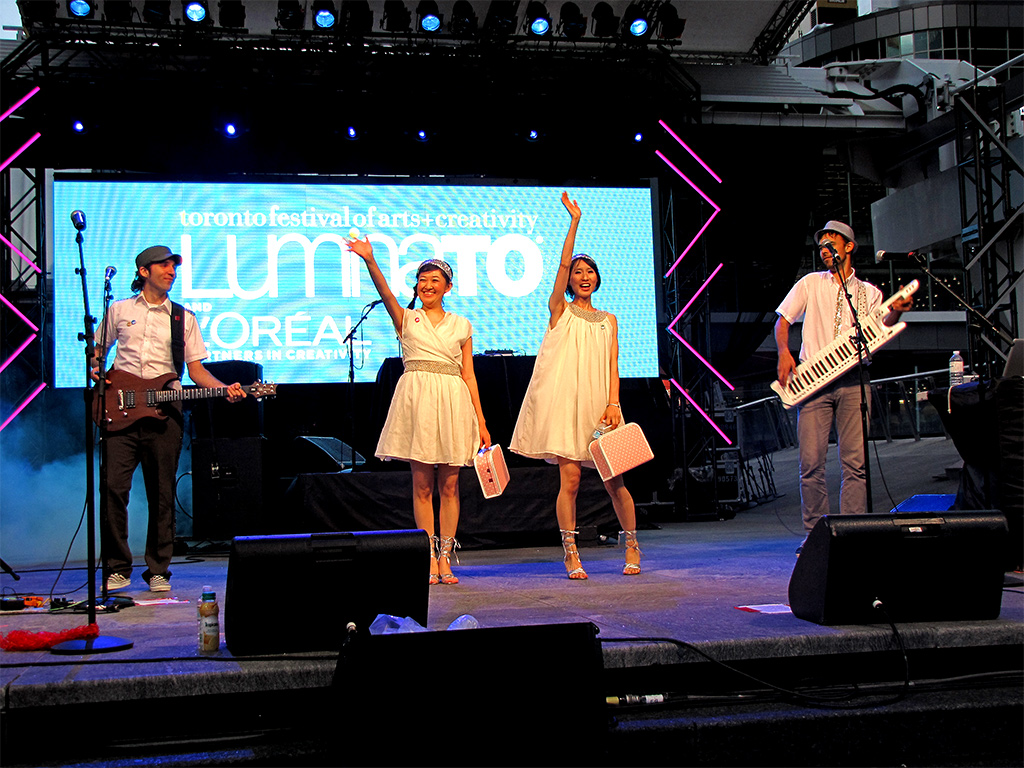
Last year’s Luminato experience, at least for me, consisted of a giant red ball, a pricey half pint of beer, and a few moments with Disco Inferno. I didn’t quite know what to make of the festival then and, to be honest, I still don’t really have a handle on what it’s supposed to be.





 ... with pictures
 ... with sounds
 ... with videos
 ... with opinions
 ... that's shorter
 ... that's longer