The Canadian Apocalypse
Posted on August 31st, 2014 – Comments Off on The Canadian ApocalypseThose Australians are on to something…



Those Australians are on to something…
According to Bill McKibben, the environment has it in for us. All of us. Like, real bad.
I got the opportunity to hear him and Margaret Atwood chew the cud on the problem at the UofT Bookstore‘s Reading Series. After all, the environment lurks mercilessly outside all of our homes, constantly waiting to pounce; needs a brainstormer, no doubt.
What I liked about Atwood was her willingness to delve into the causes of why the environment is being such a dick; let’s not be ignorant of the enemy. That and she brought up coffee and hemp as possible solutions. I like her. :)
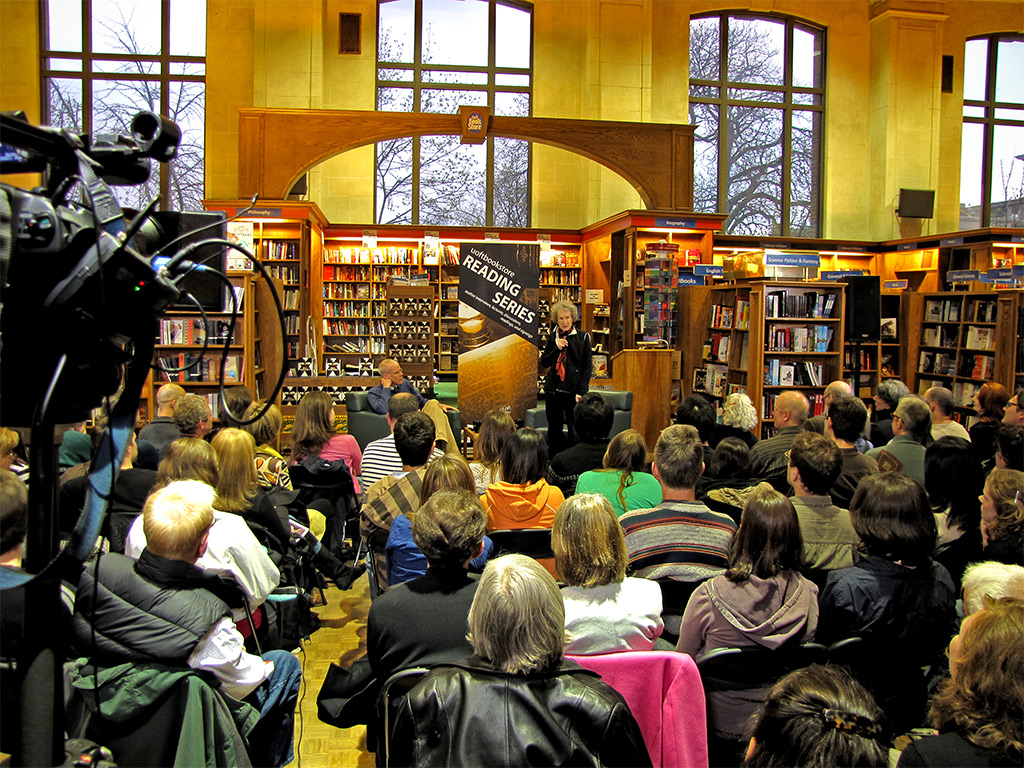
So what did McKibben have to say? Basically that, at this point, the environment is already over the edge. Forget trying to slow it down — blast that motherfucker with everything we have!!
He goes into greater detail in his new book “Eaarth”, but wants to emphasize that it’s still, “all a long shot”.

Bill’s message isn’t terribly upbeat, even though he somehow is. Diplomacy, recycling, full-on frontal attack, we’ll need to do whatever it takes if we stand a chance against the environment.
From my regular viewing of public television, I know that small island nations like the Maldives are already under attack. They’re seriously looking into evacuation plans for whole countries, that’s how bad it’s getting. And unfortunately, publicity stunts don’t really seem to be getting the word out.
Bill had a big hand in 350.org, a site dedicated to disseminating information about the struggle. And a struggle it’ll be. According to what I’ve read there, it’s not a matter of if we’ll be attacked, but how severely. The best we can do now is to mitigate the damages. I’m definitely not getting that mortgage now.
Warmest welcome once again, dear reader!
It’s so nice to have the pleasure of your company for another instalment of the Guide. I do hope that life has treated you kindly and that during the odd times when it hasn’t that you’ve had some opportunities to practice being practical. And, more importantly, that that practice has brought you some satisfaction.
In this edition I’d like to pull back from street level and look at a couple of larger forms of urban insolence: government and transit. It’s certainly not necessary to go into any sort of detail; insolence comes in many forms from both sides at this level, from new taxes to higher bus fares, and these are not necessarily local or even urban issues. In fact, as I hope you’ll find, the topics covered here have broader applications.
However, for the practical gentleman this poses a profound conundrum: does one take up arms and revolt against increasingly unjust overlords at great risk to oneself and one’s family, or does one resort to enjoyable but much less effective flaming paper bags (with surprise) left on doorsteps?
Alas, neither option seems agreeable, does it? On the one hand we must choose between radical criminal action, on the other classically amusing but ultimately ineffectual pranks. What’s the practical gentleman to do?
A great deal of wisdom has been scratched onto the walls of prisons as regards these matters, but please allow me to at least get the ball rolling:
The Continental
When one can’t be direct but wishes to nonetheless improve a situation, one must think outside the box. If more money is involuntarily leaving our pocket, more must come in to replenish it. It’s a simple balancing act. Thus, the practical gentleman takes his case directly to the people, bypassing the tight-fisted upper echelons altogether.
In this approach, we simply ask passersby to donate for charity, and I must stress strongly that this is not the same as asking for hand-outs. That would be most ungentlemanly and besides, this is an investment. To convince our fellows of this, however, we are required to present our case with a little more flair. Some call this marketing.
We simply invest in a nice colour print-out of the charity we’re representing, a nice binder to put it on the cover of, and a few hundred charitable donation “receipts” to give to anyone who requests them, to go in said binder. And a pen :) The charity is of course you, only jazzed up a bit; marketed better. Try some interesting twists on your name, combine it with a slogan, borrow a nice logo, but keep it all simple. For example, “The Patrick Fund – Fighting poverty at hom e and abroad”. The name must always be entirely truthful and you should always have a full explanation at the ready. In this case, it is a fund that is in my name and to be used to fight poverty in my home, possibly also to fight that woman I don’t much care for. With minor typographical errors.
For the logo, simply take an existing one from anything around you (using a cell phone camera, for example), and cut off everything but a quarter of the image. For simpler logos, like the Nike swoosh, you may have to use a half of the photo. Or, if cutting doesn’t produce satisfactory results, simply flip the image around horizontally or vertically. The McDonald’s golden arches easily become William’s golden catch basin — for money!
But, most importantly, you must add a prominent outline of the African continent on the logo (hence, “The Continental”). This lets people know you like geography. If you don’t, maybe now’s the time you gave it another try! People aren’t going to give their money to just any old schmuck on the street. Let them know how worldly you are, what a great investment you’ll be, why they should believe. Africa, the symbol of hope.
In this way you don’t hide behind any small print and your honesty and commitment to being upfront will shine through. The donations will come pouring in! At the end of the day you can go home satisfied that your fellow human beings have helped you because of a shared sense of civility. Take that, government!
The Convenient
Did you know that local businesses often provide instant financial support to anyone who strolls in through their front doors? It’s true. In most convenience stores, for example, often placed clearly and visibly in front of the cash register is the leave-a-penny take-a-penny bowl. Most store owners don’t contribute to it so they have no say in how it’s apportioned; it’s a social support system by the people, for the people. Including you.
Penny contributions can be made when pennies are abundant in your life. When they’re scarce, you can of course take. But be sure to do so a penny at a time, thus affording someone else the opportunity to take every alternate penny if they wish. A two-second wait period is customary unless no one else is in front of the counter with you.
The only drawback of the take-a-penny system is that some stores carry larger caches than others. I suggest carrying a strong bag (the pennies will get heavy!) and visiting as many shops as you can. Remember, those pennies already belong to you so you’re not required to make idle chit-chat with the shopkeeper. If they give you any trouble, simply threaten to call police. If this is not your style, you may instead opt to dress provocatively. Ladies will have an advantage over the gentlemen here, I’m afraid. Sorry fellas, we can’t win ‘em all.
The Economic
Many economic pundits have been putting forth the idea that being environmentally conscious and being profitable don’t necessarily have to be exclusive of each other. In fact, an amazing array of novel ideas is beginning to surface during these difficult financial times, many of them designed to produce environmental benefits, and many of those turning in tidy profits for anyone willing to put in some effort. The concept of carbon credits, for example, is ingenious but it hasn’t quite caught on yet. The problem is simply a dearth of mass adoption. This means that the market is still very much wide open … for anyone willing to roll up their sleeves and work for it.
Honest rewards for honest labour.
The further upshot of this is that the practical gentleman may rest well at night knowing that he’s earning an income from a noble pursuit, its influence continuing well into the future. The only requirement is a nice smile and a number of carbon credit certificates. There is no currently accepted standard for these – be creative, but keep the initial batch inexpensive. The idea is not to lose money here :)
Now the hard part: we go door to door selling carbon credits. There’s no trick here, you just have to shake hands, sip tea, and sell the hell outta that carbon!
Eventually, you may want to to invest in some fancy paper certificates — set yourself apart from the competition. Just work the cost into the price of the credits.
You can promise clients that each carbon credit they buy will be used to directly sequester a certain amount of green (in your pocket), ‘n house gasses. Not sure exactly what those gasses would be, but probably natural (this is a good, light-hearted jest to open the conversation with – and be sure to hug the potential client).
Of course, you must guarantee each and every certificate. Should the client ever wish to redeem it, you must exchange the credit for the appropriate amount of carbon. Although it’s difficult to get pure carbon, rough carbon (mixed with impurities) may be produced simply by burning something to ashes. This is your contractual obligation so you must honour the request within a reasonable time frame.
One of the biggest arguments against buying credits in this way is that (it is claimed) they are really used to prevent the environmental effects of burning stuff. Haha! What nuthouse did that escape from? If you buy a carbon credit, you should be able to exchange it for carbon. Who’s going to pay for not getting something? When the customer understands that this certificate is worth something, then it becomes a lot more valuable. Treat each buyer like the intelligent human being they are; logic will always wins the day ;)
You’ll have to do some research into going carbon credit prices but, since you probably won’t have any immediate competition in your neighbourhood, you may just be able to set whatever price you want. Just be sure not to price yourself out of the market! :D
I hope, dear reader, these points will help you through the tough times. They were inspired by a certain form of insolence, but their application turns out to be much broader. If the challenge was to think outside the box, hopefully that has been achieved. Certainly they are merely a spot from which to cast off, but hopefully they’ll chart a course to some pleasant tropical island with nice beaches, nice people, and nice drinks with little umbrellas in them. Even Mexico might be a nice escape.
Wishing you a bon voyage!
For the past three weeks my breakfast plans had to be put on hold because I had no tea. This was simply due to the fact that I had neglected to follow my own advice to write my shopping list while sober. Delicious, chocolate-covered snack foods always made it on there somehow, but not tea.
So it was a happy day today when I finally remembered to pick up a box at the local Metro. As I stood in line at the checkout I ran through the great conversation I would have with the cashier: “I see you bagged that tea quite expertly. Would you consider yourself a professional teabagger?”
Two things put a major damper on that:
First, the lady ringing in my box of Wagon Wheels and no-name English Breakfast Blend had a pretty rudimentary grasp of the language and it probably wouldn’t have made the splash I was looking for. It was intended for her benefit, after all; I already know how witty I am.
Second, she preempted me abruptly with, “For five cents each, would you like to buy bag, sir?”
That shrunk my enthusiasm down to embarrassing cold-water scrotum size, and it was all thanks to that new plastic bag bylaw that came into effect today. Retailers must now sell their bags to customers at a minimum of five cents a piece and at this time next year, no retailer will be able to carry bags that are non-biodegradable.
Right.
The Indian woman with the unlikely name of Linda stood there behind the counter blinking at me, waiting for a response. “I guess I’ll take one,” I replied, “but make sure to put the tea in professionally.” — DAMN IT! The whole paying-for-a-bag affair set me off kilter. In my displacement, I couldn’t quite put my finger on why this bothered me.
It’s not the concept of paying for bags that bothers me. The intent is to put less into landfills while still giving the option to people if they want them. I think that this is as far as the planning for this project went at city hall. Had they not been so eager to get out and hoist a few, they may have noticed a few byflaws in their bylaw (damn that’s witty!):
Consider this:
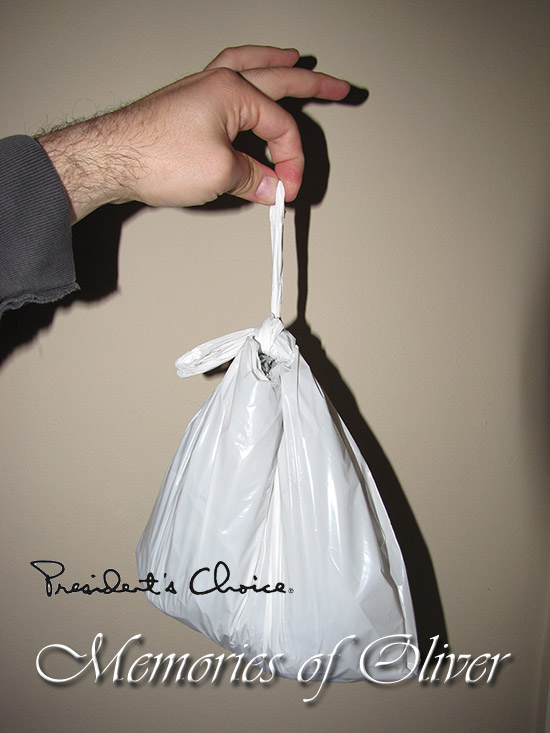
Plastic bags can be very useful and I feel it’s fair to say that no one likes to see them flapping from trees. A nickel is not a terrible price to pay for a bag that you can reuse a few times if you are so inclined. Some of the detractors of the bylaw are trying to convince people that cloth bags are cesspools of bacteria and fungi. True, if you’re keen on keeping your bag in that warm, special, moist place. So hang it up on something for a couple of days. Not really a very good argument.
Besides, plastic bags aren’t the biggest problem. I don’t mind an initiative to reduce them as long as there’s an equal share of the responsibility on the manufacturing end. Our sacks are important and everyone must lend a helping hand to support them.
I know, that was terrible. I’m still traumatized from that cashier lady.
How much do you practice the three R's?
Most readers say: A lot cuz I'm pretty good at the reading but the rythmetic is tricky.
. Loading ...


 ... with pictures
 ... with sounds
 ... with videos
 ... with opinions
 ... that's shorter
 ... that's longer