Posts Tagged ‘ security ’

Using a brand-locked Hitron CGN3 as a standalone router

Posted on February 11th, 2026 Comments Off on Using a brand-locked Hitron CGN3 as a standalone router

This is a bit of an exception from my usual posts but I thought I’d add it here since people seem to have been struggling with this for years and since you can presently get this hardware around Toronto for as low as $10.

I happen to have a Rogers-branded box but I suspect this method would work just as well for any other any other branded CGN3 models. It might even work with other branded Hitron networking devices but that’s a whole lotta conjecture on my part.

Want local router, can’t log in

As mentioned, this simple bypass will only allow you to set up the CGN3 as a standalone router and assumes that you can’t log in to configure it for this purpose (otherwise just log in and configure it!) Usually this is because the device is brand-locked (e.g. to Rogers), and requires a confirmed cable internet connection before allowing you any further.

If you’re planning to use the router for cable internet access then you should go through the regular setup outlined by your ISP. If that doesn’t work then contact them for assistance (that’s what you’re paying for!)

Otherwise, use this method to connect your WiFi and wired devices together so that they can communicate. Typical uses include LAN gaming, connecting to local networked printers and scanners, using local webcams, accessing local network storage devices, local file sharing and media streaming, etc.

Instructions

  1. Perform a full hardware reset on the unit and then turn it on (plug in the power supply).
    The manual claims that you only need to press and hold the hardware RESET button (the tiny button on the back that requires a paperclip), for about 10 seconds but I hold it longer just in case.
  2. Use a computer or tablet to connect to the CGN3.
    The manual describes both the wired (Ethernet) and wireless (WiFi) methods. You might be able to use a mobile phone for this but I haven’t tried it and it seems like it would be a pain in the ass.
  3. Fire up your favourite browser and go to the following URL:
    http://192.168.0.1/selfinstall/index.html#test_success
  4. Open up the Developer Tools panel (CTRL-SHIFT-I or CMD-SHIFT-I in most browsers) and switch to the JavaScript Console tab (often just called “Console”). Then copy and paste the following code into the console, followed by ENTER:

    document.querySelector("#test").value = "1";
    document.querySelector("#name").value = "";
    document.querySelector("#pass").value = "";
    initHistory();

  5. Turn the modem off and then on again (unplug it and then plug it back in).
  6. Reconnect back to the modem using your preferred method (see step 2).
  7. In your browser go to:
    http://192.168.0.1/
  8. Log in with the username “cusadmin” and same password as network password — blank, unless you specified some other value for the “#pass” part in step 4.
  9. Configure away! (I recommend starting with changing the admin password.)

But why?

Again, it’s a cheap option if you’re looking for a wireless+wired router that supports 802.11b/g/n concurrent dual band (2.4GHz and 5GHz) along with WPA-PSK and WPA2-PSK security. It’s got pretty flexible configuration options and it can even act as a Samba (network) storage server — just plug a USB storage device or two in the back.

I can’t say that the CGN3 is the best router I’ve ever used but it works pretty well, most of the time. For the money, I can’t complain.

Filed under: B Sides, Patrick Bay

Flying spaghetti monsters

Posted on August 5th, 2014 1 Comment

believe! (or else)

believe! (or else)

The ugly.

Harper’s propensities are a toward building a corporate-fascist tyranny in Canada.

It’s tough to find agreement on just how far Harper’s machinations have progressed, but both his actions and his words repeatedly reassure us that this is precisely what he’s gunning for.

Tyranny, according to the people who coined the word, means “one who rules without law, looks to his own advantage rather than that of his subjects, and uses extreme and cruel tactics—against his own people as well as others”.

The evidence of government tyranny can be found all over TCL — just flip through some old posts.

And fascism, according to both original and modern definitions, is generally defined as, “a form of political behavior marked by obsessive preoccupation with community decline, humiliation, or victimhood and by compensatory cults of unity, energy, and purity, in which a mass-based party of committed nationalist militants, working in uneasy but effective collaboration with traditional elites, abandons democratic liberties and pursues with redemptive violence and without ethical or legal restraints goals of internal cleansing and external expansion.”
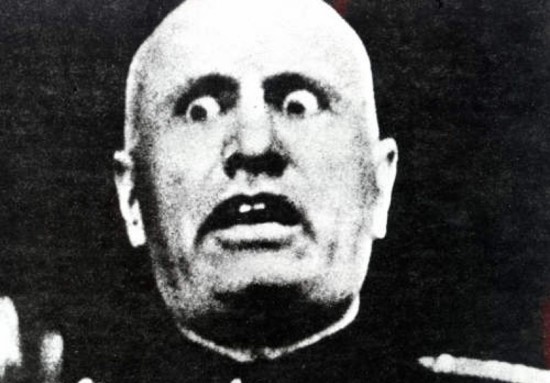
mussolini

Or, if you prefer war-and-oppression-loving Benito Mussolini’s definition: “The Fascist conception of the State is all-embracing; outside of it no human or spiritual values can exist, much less have value. Thus understood, Fascism is totalitarian, and the Fascist State–a synthesis and a unit inclusive of all values–interprets, develops, and potentiates the whole life of a people … Fascism is definitely and absolutely opposed to the doctrines of liberalism, both in the political and economic sphere”.

Lawless and absolute control over economic and societal affairs?

In Canada?

Yes, and it’s obvious: the government is a monopoly that demands absolute obeisance to itself while keeping all of its citizens in debt-bondage to the state (a.k.a. taxes that you “owe” for your entire life and beyond). The vast majority of citizens never agreed to this or its administration; rather, they acquiesced after being threatened with seizure (theft) and jail (kidnapping and imprisonment). Of course, despite the fact that they overtly demand that these are crimes, government flatly rejects any definitions other than that of benevolent benefit when they engage in them. They have to; how could they undermine their own “authority”?
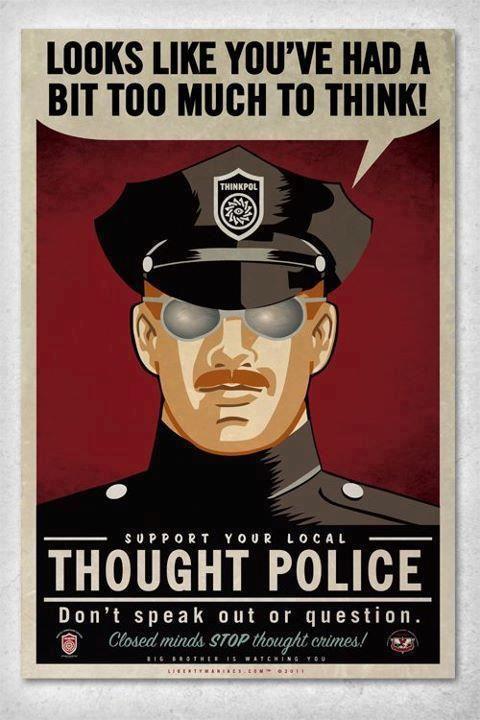
thoughtpolice

To be fair, Harper didn’t come up with the lie of calling Canada a “democracy” (which it’s simply not), or foisting the apparatus of the state to dominate and control. But he, like most other politicians, engages in stately depravity. He knows that after years of screwing over Canada he’ll be rewarded with a fat pension and lots of gifts from his international buddies for things like looking the other way to systemic human rights abuses. “Important Canadian values” my ass.

What about checks and balances?

judgejudy

Oh, you must be referring to the government-appointed juduciary (or a healthy smattering of corrupt, degenerate, ignorant and incompetent Justices of the Peace), or maybe the equally undemocratic Senate, or maybe the innumerable, undemocratic “authorities” that are imposed on us via the shell game of elections and self-appointed power of the moneyed ruling class.

So the term “fascist tyranny” is not a spurious, knee-jerk reaction or a flimsy propaganda label — it’s a sober definition based on overt deeds.

If it quacks like a duck, as they say.

Okay, so you still don’t like “corporate-fascist tyranny”? Too many memories of Nazi Germany? How exactly could Israel and Canada be such close partners given such strong overtones? How indeedhow indeed.

Very well. So if Harper himself called Canada a “dictatorship” and has been working hard to remove that “benign” prefix from the description, what exactly does that make him? And what does that make Canada?

The bad.

The awful arguments of moral relativism — “at least we’re not as bad as _______!” — imply that anything and everything goes as long as our government doesn’t behave like those animals in other countries.

This means that all that needs to happen is for continuing debasement and destruction of those countries (helped along, of course), for the argument to remain valid. They might behead you arbitrarily over there, so it’s okay for us to torture you here. When they get to doing unspeakable things to children, you being merely beaten and imprisoned for having adult opinions is perfectly acceptable … helluva lot better than what they’d do to you.

Price of freedom, buddy.
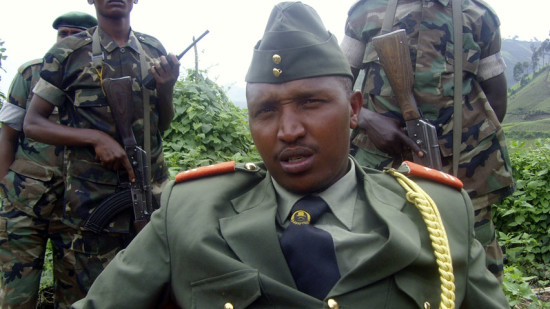
hicongo-ntaganda

And … AND terrorism!

Oh yeah…terrorism. Who’s responsible for that again? Surely we need our government to protect us from all those baddies! Okay, so some (unbelievably audacious and fundamentally illegal), abuses might happen, but surely those people will be held to account.

Yeah, surely.

Obviously.

The moral relativist is in most arguments in favour of a race to the bottom, to the very worst crimes and debauchery that humanity can think up — as long as those crimes are slightly better than the other guy’s. The concept of absolute, inhuman control by the fascist state is mirrored in its mindless apologists, along with all the overt lies about your “protection” and “safety” (Terrorism! Crime! Environment! Lefties! Traffic!)

Even if you don’t believe that we’ve arrived at this point, is this what we should be striving for?

Even if you believe that this is merely incompetence, is it logical to depend on the very same people who created and perpetuated these problems for decades/centuries to miraculously fix them?

Okay, I know I’m hammering this topic pretty hard, but only because I absolutely know that the time to take a solid stand is now. The march of corpo-fascism continues across North America and elsewhere, fully promulgated by our “democratically elected” leaders.

All tomorrows are too late.

The good.
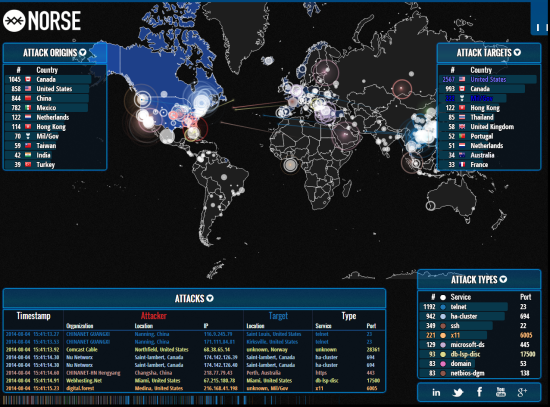
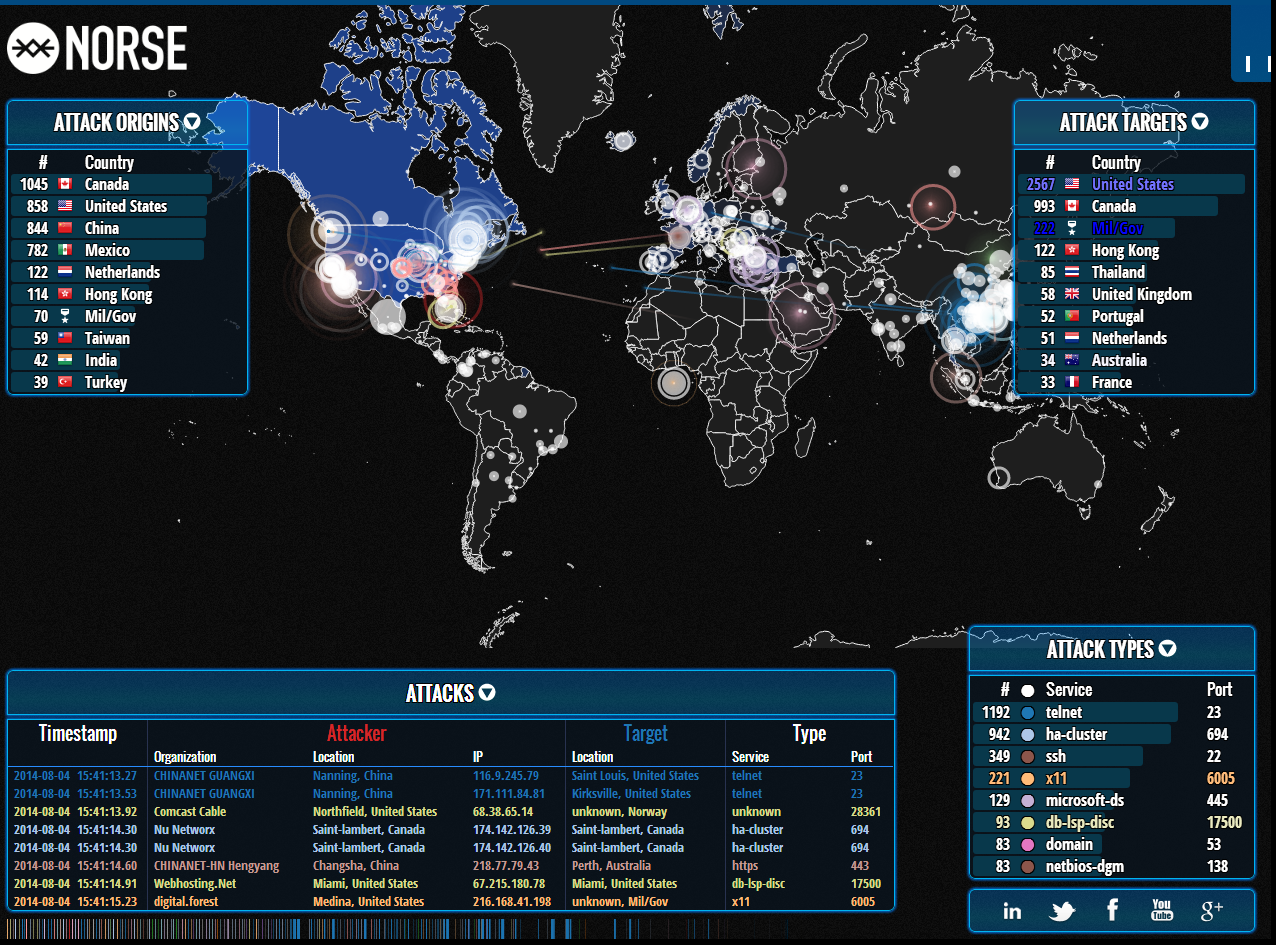
IPViking attack map

The map above is from Norse Corporation’s IPViking Live site where you can see many of the world’s cyber attacks in realtime.

While a map of attacks in the ongoing “cyberwar” (a fear-based buzzword), may seem like utter devastation, it really only shows good old-fashion hack ‘n crack activity with the occasional DDOS attack (nothing more than the target being overwhelmed with too much intentional internet traffic — a very brute-force technique).

In fact, aside from a change in connectivity and some improvements in security, many of the underlying penetration techniques haven’t changed much since I was a pimply-faced, war-dialing teenager.

war_games

What the map reveals, however, is that Canada’s internet connection to the world is still somewhat open and unencumbered (net neutrality not withstanding), which is confirmed by the the renewed attention of the copyright goon squad.

Better still, the increasingly brave belief in privacy and anonymity (and moreover simply basic justice), are alive and well in Canada. It is increasingly Canadians who champion truth, justice, and democracy (in the truest sense), around the world.

Take, for example, Montreal’s Subgraph. They come right out of the gate with a firm declaration:

Subgraph is an open source security company.

This means that we believe that open source means the best possible assurance of security at a time when trust is increasingly challenging.

Subgraph takes its inspiration from the domain of cryptography where proprietary algorithms are never trusted, and extends this principle to software.

If a proprietary algorithm cannot be trusted, why trust proprietary, closed-source security software?

I like where they’re going with this. I also like that they’ve taken on the task of creating Subgraph OS and Mail, a much-needed alternative to Tails which is a fully self-contained operating system built around security, privacy, and anonymity that has recently received some skepticism.

Closer to home we find the University of Toronto’s Citizen Lab, a group dedicated more to threat analysis and neutralization rather than the creation of new products (though they sometimes make those too).

Citizen Lab is lead by Ron Deibert who Sarah informs me often carries himself (and is received as) a rockstar, probably because of stuff like this:

…he was sitting on a panel with John Adams, the former chief of the Communications Security Establishment Canada (CSEC), the National Security Agency’s little-known northern ally. Afterward, he recalls, the former spy chief approached and casually remarked that there were people in government who wanted Deibert arrested—and that he was one of them.

It’s a bit freaky to hear that,” Deibert said when he recalled the Calgary encounter in an interview with Ars. “When people ask, ‘are you worried about the Chinese or some other adversary out there,’ I say I’m always a bit more worried about my own government, because this is the kind of thing I hear occasionally.”

It’s Citizen Lab’s razor-edge stride between academic rigour, establishment paranoia, and charisma that make it both a formidable force as well as a model for what I think needs to happen, at least in the online world. Increasingly, I believe that Citizen Lab is an example of the type organization that freedom and truth-minded individuals will come to rely on — a group of enlightened individuals who know what time it is.
flavaflav

If you don’t go for these freewheeling hippie types, there are older and more established schools of thought that underscore this entire line of thinking; schools like the Rothbard Insitute, another academic but considerably stuffier organization espousing individual freedom through “radical” economic ideas, and the Mises Institute which runs along similar lines.

On the political front we find groups like the Pirate Party which, despite the malignancies heaped on the name by the corpo-state, is ultimately for individual rights and freedoms:

To describe the goal of the Pirate Party in a single word, I would use “empowerment”. The beauty of the Internet and information technology is the ability for a poor child to have the same opportunities to create change as a wealthy privileged adult. It is the goal of the Pirate Party to encourage that strength, and to promote values which will empower every Canadian.

And if Rothbard or Mises are too rigid for your enjoyment, there are many bright, well-spoken, informed individuals out there that help to bridge the gaps; everything from applicable advice to thought-provoking witticisms.
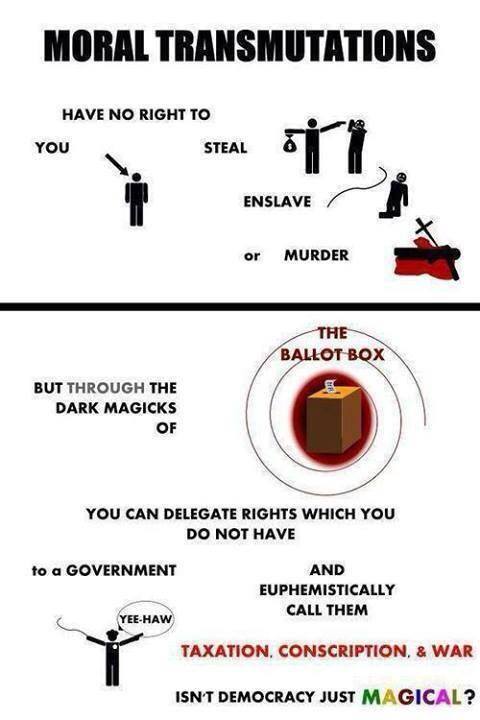
magical democracy

Complacency and continuing acquiescence are, of course, an option. Going along with or supporting the increasingly fascist state are another. We could also worship the flying spaghetti monster, believe that voting makes a difference, trust that government is working for our benefit, etc.

We have some good examples of how such beliefs work out … maybe it’s time for something different this time?

Filed under: B Sides, Patrick Bay, Pictures

You are being watched

Posted on August 22nd, 2013 Comments Off on You are being watched

At one time, my mentions that we are being illegally tracked by our government/corporate owners were derided as conspiracy gibberish, along with the verbatim “tinfoil hat” comments that all such enlightened contrarians regurgitate, despite the reams of independent, corroborative evidence I would trot out.

Then, with the news of NSA spying scandal came confirmation that, yes indeed, this is exactly what’s happening and if anything I didn’t go far enough in my descriptions.

None of it is news to the informed, to be sure, and there is enough independent verification going back many years from the best sources one could find — there’s absolutely no doubt that we are being spied on constantly, and that our government is forcing this on us at the behest of private, for-profit, and for-control interests. Even if you believe the highly incredulous claims that CSEC, Canada’s version of the NSA, is not spying on Canadians, there’s no doubt that our neighbours are only more than willing to do so and to share that information with CSEC:

CSEC relies on its closest foreign intelligence allies, the US, UK, Australia and New Zealand to share the collection burden and the resulting intelligence yield. Canada is a substantial beneficiary of the collaborative effort within the partnership to collect and report on foreign communications.

The issue of why the government is doing this usually pops up at this point. The naive assumption is typically that this is being done for the protection of citizens (terrorism!) and that even if our data is temporarily stored and analyzed, ultimately no one is interested in harvesting all of your innermost secrets.

Of course, I’ve already mentioned that the government is imposing these measures on behalf of power-hungry organizations seeking global domination (is that sufficient motive?), which also sounds like a conspiratorial rambling — if only it weren’t for the fact that CSEC directly states this on their website:

The IT Security Program has earned highly valued global respect and a reputation of technical excellence. It now extends its expertise past its traditional technical clients to those within the Government of Canada who are responsible for the formulation and implementation of policy and program managers. This approach encourages harmonization between Government of Canada’s operational IT security requirements with its business needs and processes.

The IT Security Program will aid the Government of Canada’s effort to make cyber security a business enabler.

It’s fair to say that protecting profits, whether government or corporate, isn’t CSEC’s only job:

During the Cold War, the Establishment’s primary client for signals intelligence was National Defence, and its focus was the military operations of the then Soviet Union. Since the end of the Cold War, Government of Canada requirements have evolved to include a wide variety of political, defence, and security issues of interest to a much broader range of client departments.

While these continue to be key intelligence priorities for Government of Canada decision-makers, increasing focus on protecting the safety of Canadians is prompting greater interest in intelligence on transnational issues, including terrorism.

Here CSEC, under the reliable guise of “terrorism”, is openly promoting surveillance and spying. Note how there’s no mention of protecting citizens from predatory governments or other large organizations with the means and proven willingness to do real harm.

The agency, unsurprisingly, works hard at convincing everyone that with every new power they’re granted they’re being extra cautious and rigorous, but such words are hollow and meaningless when cut short by insistence that actual details are top secret and therefore you can’t know about them.

I’m not the only person to point this out, but what is clearly apparent is that the government and all of its shadowy organizations are focused on protecting corporate and government interests while either ignoring are actively eroding individual rights and freedoms. Their words are loud enough by themselves, but their actions practically scream their intent.

This is not only enshrined in both the despicable mandates and lack of any accountability underlying CSEC, CSIS, and other such groups, but we see real-world examples of what is truly important to their operations. Between destroying potentially incriminating evidenceallowing international spying to happen under their noses, being watched over by fraudsters, and championing horrific laws, it’s really hard to see any of them as the cheerful, helpful, protective entities they claim they are.

You can go even further to prove this for yourself by calling any government agency, whether it’s the Canada Revenue Agency or the Public Safety Ministry, and ask the person on the other end the simple and blunt question: does the government work for the people or do the people work for the government? The answer should only be, “but of course the government works for its people!”, and part of that work should include being able to answer this question; however, it’s highly unlikely that this is the response you’ll receive. In fact, you should take a moment to relish the derision and/or idiocy you’ll receive as a response from the people who you’re paying to force you to jump through hoops for — then you’ll be clear about who is expected to bow to who.

This seems so juvenile and simple that few people would bother actually picking up the phone and learning the disturbing truth for themselves. Instead, they will wrap themselves up in yet another layer of delusion and will, by corollary, have answered their own subsequent questions about how governments and corporations are able to get away with this, how people could be so blind and blasé as to allow it to happen, etc.

The question, for those of us who can add two and two, is not whether we’re being tracked and surveilled, it’s what we can do about it. The idiotic claim that, because we’ve done nothing wrong we have nothing to hide can be re-stated equally as simply as because we’ve done nothing wrong you have no right to watch us. In fact, if these agencies are so squeaky clean, why do they obstinately refuse any oversight or inspection? If they didn’t do anything wrong, why do they refuse to answer any questions?

Because it’s one standard for us, the reprehensible child-molesting rabble who should count themselves lucky to be protected from all those nefarious terrorist plots, and another standard for our historically benign and loving government/corporate owners. And when we complain about this inconsistency, we’re reminded in less-than-gentle ways that their 24% support represents a “majority” and if we don’t like it we need to shut the hell up and wait until the next “fair” election.

When we see corporate-backed governments collaboratively going after those standing up for truth, honesty, openness, and justice, even when those people have not broken any laws, while the governments themselves, at the highest levels, are openly breaking law after law and engaging in open fraud and deception, it’s obvious what side of the moral/ethical/legal debate the “authorities” stand on, and moreover, who their number one enemy are.

The sad thing is that the willfully ignorant still expect tanks to roll through the streets in order to recognize the action as a coup, never once thinking that guns and bombs don’t need to be used when gullible fools like them unwittingly and gladly hand over everything to their criminal overlords.

Filed under: B Sides, Patrick Bay

This way to your despotism, folks!

Posted on August 4th, 2012 Comments Off on This way to your despotism, folks!

I was planning on going down to Caribana today but the heat and humidity were so oppressive, I thought better of it early on.

And that wasn’t the only thing that was oppressive:

Police, volunteers and private security guarded entrances to the Scotiabank Caribbean Carnival, patting people down and searching bags before they entered.

A network of barricades and fences kept the public back from the dancers with glitter-dusted skin and colourful headdresses as they made their way down Toronto’s Lakeshore Blvd.

“There’s so much fences that I can’t hardly see anything,” said Ann James, a nurse from Bloomfield, CT., who was trying to find her way to the end of the parade route.

Pat downs? I thought there weren’t going to be any pat downs! And I thought they were supposed to be reserved only for the saps in the bleachers … you know, all the lowlife criminal scrum like families and the elderly that attend the parade.

And now that I think about it, I’m certain that I mentioned that this was going to turn out to basically be security theatre intended to intimidate the general public.

And now, having mentioning these things (and incidents involving police acting as simply armed thugs, not enforcers of the law), I’m sad to report that they happened last night and today exactly as I predicted.

In fact, Sarah and I decided to go out for some chicken wings in the evening and I don’t remember seeing such a ridiculous number of cops on the streets since the G20. There were cops from all over; Peel Region, Waterloo, Halton. And they were parading around in gaggles of anywhere from four to ten at intervals of — and I’m not exaggerating in any way — every single block around the city core. At times there were more cops than pedestrians.

And I can’t tell you the number of parking enforcement cops that simply strolled by cars parked in front of fire hydrants and blocking intersections, right in front of our wing place, no more than a meter away from us and clearly visible through a huge glass pane window. To put it another way, the police weren’t enforcing the law, they were out to make sure we all saw their presence.

You may, at this point, be wondering if the word “despotism” was accurate in the title of this post. After all, it’s a pretty weighty word with lots of nasty connotations. Well, how about we let Encyclopedia Britannica explain (and while you watch, keep the banking bailouts, growing disparity between rich and poor, government censorship and gagging, and the near dictatorial pronouncements and oppressive, repressive laws and practices coming from both down south and here from Harper’s Canada, in the back of your mind):

Filed under: B Sides, Patrick Bay, Videos

Down the rabbit hole

Posted on July 25th, 2012 Comments Off on Down the rabbit hole

Remember yesterday when I was talking about the seeming unwillingness of the government to curb violence? I’m sure I’m not the only one to notice this, but the only conclusions that people are drawing are that Harper and his cadre are doing this either through sheer incompetence or some level of meat-headed obstinance that simply won’t allow them to do anything else.

Except what if there’s a third option? One in which this is a cold, calculating move designed to get us all under the yoke of a tyrannical government. I mean, you only have to look as far back as Bills C-11, C-10, or C-38 (the Omnibus Crime Bill) to see exactly where they want to take Canada, and it’s a very ugly direction indeed; Orwellian, even — and that is not an exaggeration by any means.

And if you doubt that, today’s news offers an early glimpse into the plan made incarnate at this year’s Caribana (you know everyone still calls it that!) Here’s just a sample of what they deem is “normal” for private security (these aren’t even sworn police officers, and this is in a public place):

Security guards will be searching visitors’ bags for alcohol, drugs and weapons.

[Organizer Stephen] Weir said the people who usually purchase bleacher seats are seniors, families with young children and tourists. He doesn’t expect pat-downs will be part of the screening process.

Oh, he “doesn’t expect” pat downs will be used on children? That means that, yes, most certainly the troglodyte security goons will most definitely be grabbing at your kids’ genitals, a la US TSA gropings. And since these are mostly elderly and kids and families sitting in the bleachers, off course they need to be the subjects of a security crack-down. They are, after all, typical of the most despicable criminals out there. Makes sense, right?

People are unfairly linking us with an event in another part of the city that was really tragic, but we should be doing this.

Oh, it’s unfair. We don’t have a violent event, so of course we’ll be frisking people. And only the the law-abiding citizens who paid for their tickets; everyone else just walking around on the street won’t be subject to this. Makes sense, right?

If you’ve brought in food and non-alcoholic beverages, we don’t care. But if someone tries to bring in drugs or alcohol or projectiles and the worst-case scenario, a weapon, we have police standing by.

So what exactly is the point of security then? You know, it’s one thing to watch the crowd for sketchy people, but frisking people and rifling through their bags, especially when they’re families, elderly, and kids, has only one purpose, and it’s exactly the same purpose that the police at the G20 were put out in such force and ended up breaking the law in far larger numbers than even the demonstrators (who actually had larger numbers): fear and intimidation.

If you doubt this, read the official reports on the G20 (I’m sure I link to them from this blog somewhere). Does that help to answer why the police didn’t give a fuck when the vandals were wrecking Toronto? They weren’t there to serve and protect — it’s that simple.

They are not there to help you, they’re there to teach you to kow tow to authority, to demand that you allow flabby fucks to manhandle your kids, to scare you into obeying whatever commands they issue, even if they themselves have no more authority than the average citizen on the street. It’s important to repeat this last part, because in a public place like the Caribana parade, you have as many rights as any pudgy fuck with a pseudo-badge and a hard-on for fondling your wife’s breasts. And if you don’t like it, you can be sure that there will be hundreds of security cameras recording your every move, without your knowledge or permission, exactly as described in Orwell’s 1984.

Just today I saw two police cruisers in Allan Gardens and four bicycle cops for a total of eight uniforms busting an old man. One of the officers was doing a little jig while two others were laughing up a storm; the old guy just stood there looking down at the ground. Ridiculous? Of course not, it’s fear and intimidation; they’re doing their jobs!

You know, if the evidence fits then whatever the theory it supports must necessarily be true, and frankly all the crap that the mayor and the mainstream keep throwing at us makes no sense at all (see above).

Q.E.D.

Sadly, most people will just go along with our descent, much to the resounding joy of Harper and his underlings who see their hellish visions of a “modern” society coming to life, and these people will cower in fear and bow to “the authorities” (whoever they claim to be), whenever they’re told to.

This is just the very beginning.


Filed under: Patrick Bay, Why I'm Right

CSEC opacity increases, your rights decrease

Posted on June 16th, 2012 Comments Off on CSEC opacity increases, your rights decrease

As I mentioned in my first PatrickBay.ca audiocast (which I’m itching to pick up again real soon), one of the topics that got me started on this blog was Canada’s version of the NSA, the Communications Security Establishment of Canada or CSEC.

What both fascinates and terrifies me about organizations such as CSEC is the cloak of secrecy under which they operate. While being all undercover makes a certain amount of sense, it also lends itself to a great deal of abuse. The little bit that we can glean from accounts such as Mike Frost’s book Spyworld leaves a very bad taste in my mouth — the agency has no problems spying on even the highest levels of government for undetermined reasons, meaning that none of us peons are excluded from warrantless surveillance.

Where CSEC feels something is out of its jurisdiction it simply asks a foreign security apparatus to pick up, thereby absolving themselves of any wrongdoing, and the whole thing is anonymized and removed from oversight anyways meaning that even if such actions ever came to light they would never be linked to anyone in particular. It’s a free pass to do whatever they please to anyone they like. And such behaviour has been going on for decades — proposed laws such as Lawful Access are merely an attempt to broaden and legitimize it for wholesale use across Canada (and elsewhere).

Continue reading at: http://patrickbay.ca/blog/?p=4048

Filed under: B Sides, Patrick Bay

RCMP G20 report, let the bullshit begin

Posted on May 14th, 2012 Comments Off on RCMP G20 report, let the bullshit begin

Hard to know where to begin on the recent report by the RCMP exonerating itself (surprise surprise) of any wrongdoing during the G20 summit here in Toronto. How about responsibility, for starters. Well, you all remember the infamous kettling incident where the police just rounded up everyone walking through the street, encircled them, and kept them standing in the rain for hours? Who was responsible for that again?

Bill Blair said, yeah, the Toronto Police gave the orders:

“I do acknowledge the operational command decisions were being made by a Toronto police superintendant who was the operational commander at the time here in Toronto,” he said.

How very interesting, considering the RCMP report claims that they were calling the shots.

 The RCMP assumed the role of security lead by authority of the G8 Summit Privileges and Immunities Order, 2010-2, and the G20 Summit Privileges and Immunities Order, 2010. These orders created the legal basis for Canada to host the Summits and, accordingly, provided the RCMP with authority pursuant to the Foreign Missions and International Organizations Act to take the lead role for security of the events.

The decision makers for the G8, in descending order, were the Executive Steering Committee, the UCC Commander, the Area Commander and the Site Commander. POUcommanders, if deployed, were given authority to make decisions with respect to the tactics and equipment to be used during time-sensitive operational situations. A similar matrix was created for the G20, but an added level of Jurisdictional Commander, e.g. the MICC Commander, appeared below Site Commander to reflect the addition of the MICC.

When asked what his [ISU’s Lead] expectations were of the UCC Commander and the TACC Commander in this situation, the ISU Lead stated that he would only expect the UCC Commander to get involved if there had been a strategic need to do so (e.g. need for additional resources). The ISU Lead was clear that the kettling was a tactical decision—that is to say, it was made by the Toronto Police Service.

Even more interesting is the claim that the RCMP broke their own rules in kettling protesters:

The RCMP reluctantly participated in kettling protesters at the G20 riots in Toronto in 2010, under orders from the local police, even though the controversial crowd-control technique is not part of the Mounties’ playbook.

So right out of the gate we have the Toronto Police claiming to give orders to the RCMP while the RCMP claims it was in charge (a number of times), and then admitting to using tactics contrary to its own “playbook”. The a TPS tactical decision overrides the RCMP’s stated policies? And who’s in charge again?

Moreover, it is the RCMP stated policy “always” to give crowds a way out.

Then there’s the back-pedaling being done on Bill Blair’s secret law (suddenly and without warning applying it to half of downtown Toronto , even when many people directly asked, certainly made it “secret”):

Documentation provided to the Commission indicates that the Public Works Protection Act regulation was enacted in response to concerns expressed by the Toronto Police Service that officers would not be able to demand identification from those wishing to enter the area in which the Summit was taking place.

“Wishing to enter”? Funny, that’s not how it was either interpreted or enforced. In fact, the law says a few different things that don’t coincide:

Powers of guard or peace officer

3.A guard or peace officer,

(a) may require any person entering or attempting to enter any public work or any approach thereto to furnish his or her name and address, to identify himself or herself and to state the purpose for which he or she desires to enter the public work, in writing or otherwise;

(b) may search, without warrant, any person entering or attempting to enter a public work or a vehicle in the charge or under the control of any such person or which has recently been or is suspected of having been in the charge or under the control of any such person or in which any such person is a passenger; and

(c) may refuse permission to any person to enter a public work and use such force as is necessary to prevent any such person from so entering. R.S.O. 1990, c. P.55, s. 3.

There was no provision for arrest if you didn’t “show your papers” simply walking around the fence, even though that’s exactly what the cops did, even though it’s obvious that this really only applied to people wanting to get inside the “Public Works” area. There’s also a lesser-known tidbit from around that time:

The Integrated Security Unit, comprised of security bodies including the Toronto police, RCMP and OPP, were concerned that lawyers were advising radical activist groups that police have limited right to question, identify and detain individuals near the fenced secure area downtown, Mukherjee said.

Blair made the request after ISU members decided extending the powers in the act, which covers buildings including Union Station and Toronto police headquarters, to the G20 fence, he said.

“The decision makers felt that a clearer articulation of what those limits are would be useful. It was not chief Blair alone. It was the ISU,” said [Police Services Board chair] Alok Mukherjee.

How about that? The RCMP claims in their report it was Toronto Police Services alone that “expressed concern” (i.e. wanted to terrorize people on the street without warrant), yet articles from that time show the RCMP (and the OPP) were in on the push for the secret law right from the get-go.

One of the more blatant lies maintained in the RCMP report is that police acted in good faith by “pre-arresting” people before they had a chance to cause trouble at the G20:

During the lead up to the commencement of the [G20] Summit, intelligence led threat assessments will be prepared by the Joint Intelligence Group (JIG). These reports will document threat levels relating to terrorism threats and planned protest threats.

The ongoing intelligence from these reports will have an impact on the deployment of human and material resources, where the potential for confrontation between protestors and police personnel are likely to occur. G20 Operations personnel conducted Vulnerability Risk Assessments in Toronto in December 2009 of the proposed venue, airport and hotels.

All “targeting” will be based upon criminal predicate: Suspects will be determined based upon their proven willingness, capacity and intention to commit criminal acts and/or create situations that pose public safety concerns.

The RCMP conclusion:

Finding No. 8: The JIG appropriately identified and assessed criminal threats to the Summits.

That a fact? Of the 70 or so pre-arrests that were “appropriately identified and assessed criminal threats”, how many of the charges stuck? Literally none. In fact, this was pretty much par for the course during all police actions during the G20, yet the cops managed to completely miss actual trouble-makers, and this more than once.

These are just three examples in the report. I haven’t even read the whole thing and already I’m finding the stench of bullshit unbearable. If you’re willing to hold your nose long enough and find more “inconsistencies”, I’d love to hear from you and append them here. I’m sure it’s filled with examples of this kind of crap which the mainstream media are missing in favour of easy-to-read, highlighted admissions of failure.


Filed under: B Sides, Patrick Bay, Why I'm Right

Rock, blog, and a hard place (part 2)

Posted on June 23rd, 2010 Comments Off on Rock, blog, and a hard place (part 2)

…continued from part 1.

And then there are the protesters.

Obviously I believe that they have something to protest. Even the groups that I think are mostly out to lunch deserve to have their voices heard. And both the government and the security forces have repeatedly stated that people have the right to peaceably demonstrate. I mean, putting the “official” demonstration area twelve blocks north of where the summit is happening is laughable, but at the same time, the few recent protests that have taken place moved around the city pretty much unimpeded. Accompanied by Toronto police, of course, but with the cops actually “keeping the peace” — as advertised!

As I’ve been careful to point out, most of the police I’ve encountered so far have successfully walked that thin line between enforcement and accommodation. Good people, and I get the impression that they got into policing for all the right reasons. Basically the kind of cops you’d want policing your streets. And I’ve already spent enough time berating those officers that seem to be ready to cross over the aforementioned line in a non-accommodating way (though the opposite is just as bad).

At the same time, the extra security around town isn’t entirely unwarranted. The tactics being used or espoused by some of the protest groups run the gamut from just plain dumb right up to outright violent. That protest on Monday, for example, the one that I ended up missing while I was having my chat with the riot police, that one ended up at an Esso gas station not too far away. It was a mostly peaceful march and the gas station was occupied for only about 10 minutes — but what the hell was the point?

Presumably the protesters were intending to hurt the Esso Corporation, but none of them seemed to be able to pull their heads out of their asses long enough to realize that a single gas station isn’t the corporation. Most of these stations are operated as franchises by individuals. These people invest in the business, as with any other franchise, and then pay the head company for products, deliveries, etc. Admittedly some locations do better than others, but attacking them is basically the same as attacking individual business owners. And their families. And the customers. Taking over a single location really doesn’t do a whole heck of a lot of damage to the corporation, just to the very people that these protests are supposed to be supporting.

Here again the police exercised restraint and wisdom and let the protesters stick around for a little while before moving them off. Frankly, I believe in property laws (I don’t want random people barging into my place!), so I thought the cops were being quite generous. Plus, as someone who’s had to sit in traffic while placard-waving idiots walked by my car and banged on the hood, blocking off traffic is not something I necessarily approve of. Okay, yeah, a peaceful march and a few minutes of inconvenience is fine. But again, we’re all roughly in the same boat so who are these protests really affecting?

So obviously some of these protesters are missing the point. Wonder if they ever had it to begin with. But they had their fifteen minutes, wasted it, see ya next time.

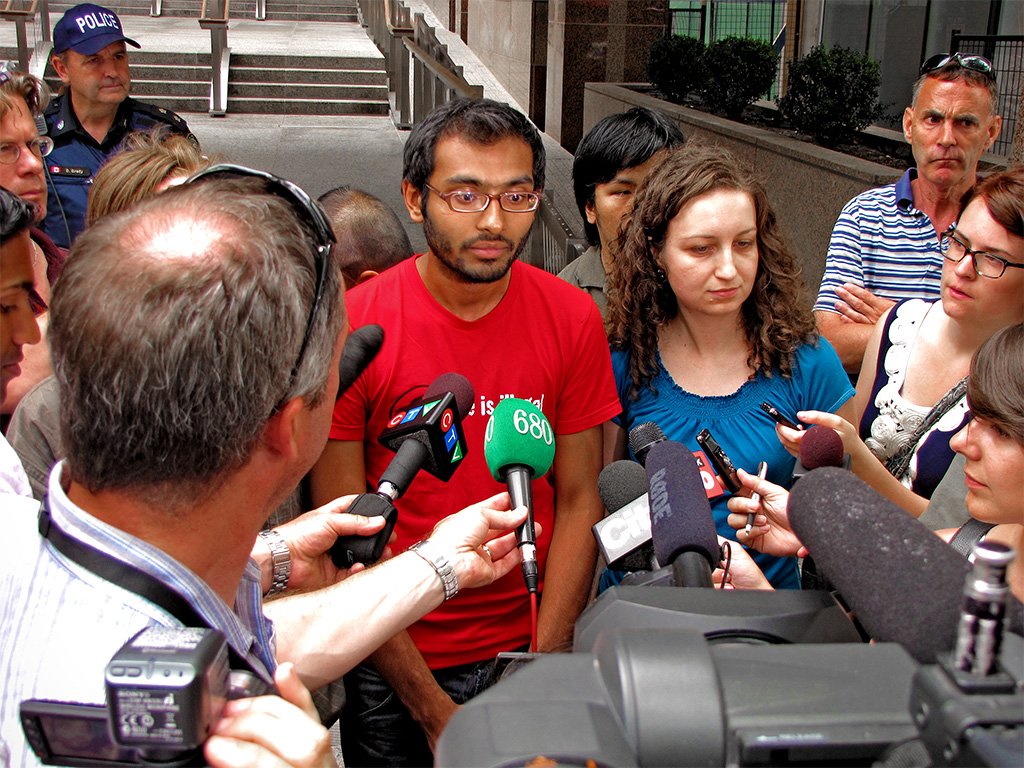
When they mix violence into it, however, that takes stupidity to a whole new level. And if the Toronto Community Mobilization Network (responsible for putting up, feeding, and organizing most of the visiting protesters), bothered to give it any thought, they’d denounce violence in a heartbeat.

sayed hassan, legal counsel, toronto community mobilization network, protests, protestors, g20, g8, security, police headquarters, carlton street, toronto, city, life

… Continue Reading

Filed under: B Sides, Pictures

Rock, blog, and a hard place (part 1)

Posted on June 22nd, 2010 Comments Off on Rock, blog, and a hard place (part 1)

My ex-wife used to call me a critical [replace with colourful afjective]. I’m starting to think she may be right.

I mean, the G20 meeting is easy to criticize. The cost, the purpose (or lack thereof), the way the rights of the citizens of Toronto are seemingly being shoved aside without regard; yeah, that all needs to be questioned.

Now more than ever, it seems.

Folks who follow my tweets will no doubt have read about my concerns about the seeming lack of any legal basis for any of the security restrictions. And that’s not just me saying that. Plus, I’ve been asking police what laws I’d be breaking should I breach the security barriers or if I fail to comply with their demands. Not that I necessarily plan to do so, but I’m deeply troubled by the fact that the police themselves don’t know what, specifically, they’re enforcing. If there’s a law (or laws), so be it — if I don’t like it then there’s a system through which it can be changed. But if there is no law…

In other words, if I was put into handcuffs, what would I be charged with? Keeping the peace, protecting private property, these things I understand and respect, but I want to be assured that I can’t be detained for no other reason than “heightened security”. That’s not a law, that’s an excuse, and a very dangerous one at that.

And that’s no longer just my pontification on the subject.

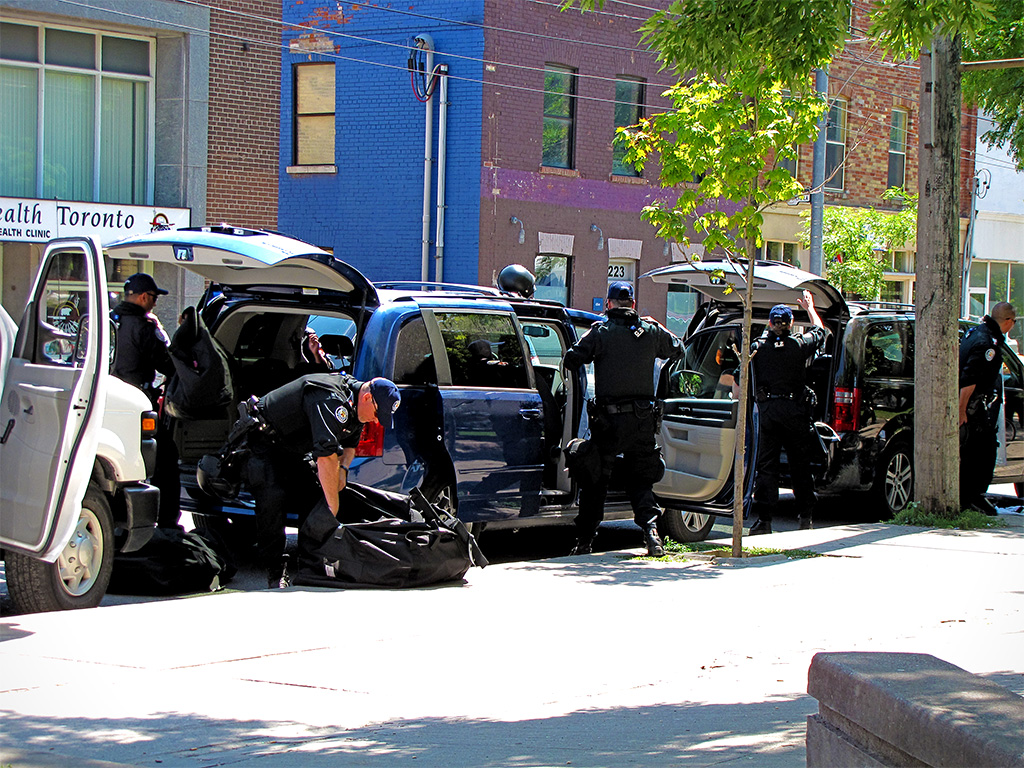
In the middle of the afternoon yesterday I heard about an impromptu protest being staged by the Toronto Community Mobilization Network, a group playing host to many of the protesters coming to the city. They started their march in Allan Gardens, moved down adjacent Sherbourne Street, and were routed west along Dundas by police until they decided to “take over” an Esso gas station at Jarvis. This route wasn’t planned in any way and by the time I got to Sherbourne the group was gone. I though they might’ve moved farther south so I continued along Sherbourne to Queen Street East. There I spotted a number of unmarked vehicles carrying riot police – must be the spot the protesters are heading towards, I thought.

g20, g8, riot police, queen street east, toronto, city, life

… Continue Reading

Filed under: B Sides, Pictures

The G-20, everything you probably didn’t want to know (part 2)

Posted on June 12th, 2010 3 Comments

…continued from part 1.

After researching what the G-20 does, I have to say, I really don’t think that they’re this evil body of leaders bent on taking over the world that some people suggest. I mean, I suppose it’s possible, and I guess you need to have some megalomaniacal qualities in order to get to that level in global politics, but it just seems like they spend most of their time sitting around eating munchies and making nice-to-do lists. I can’t begrudge them that, it’s what I aspire to myself.

But does it deserve the amount of money that our government is throwing at it? Will the, at present, C$1.2 billion be the sound investment that they’re saying it is?

Yes, that’s billion. I know, seems pretty high to me too, but to be honest I’ve never held an international summit so I wouldn’t know how much to ask for at the door. And, yeah, if we’re going to have global leaders here, we should probably buy them the good munchies, not the dollar-store crap. Presumably this second option is what was chosen in Pittsburgh, the location of the last summit, where they spent US$12.2 million (roughly C$13 million).

The costs over the past few summits (these are estimates because, apparently, these figures didn’t warrant detailed tracking or further study), are:

  • 2009 (U.K) – US$30 million (C$30,000,000)
  • 2009 (U.S.) – US$18 million (C$18,000,000)
  • 2010 (Canada) – C$1.2 billion+ — projected

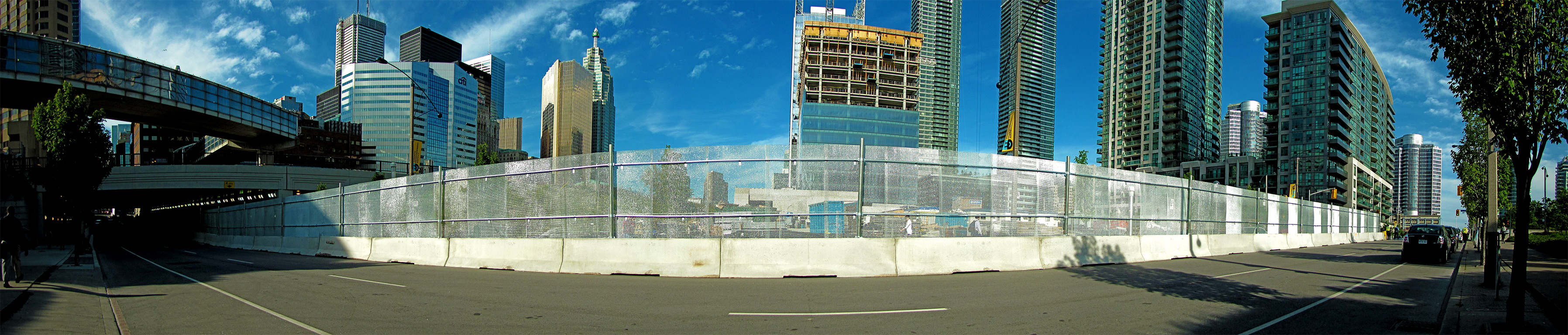
It’s estimated that about half of this, or C$500 million, is being spent on security. That’s gonna be some security!

g20, security, perimeter, fence, fencing, lower simcoe street, toronto, city, life
… Continue Reading

Filed under: B Sides, Pictures