Posts Tagged ‘ housing ’

Did it just get ornery in here?

Posted on June 14th, 2013 Comments Off on Did it just get ornery in here?

Robbie’s having a rough day. Maybe it has something to do with that pesky crack tape that just won’t seem to go away. Maybe it’s because he just can’t make any friends.

“I don’t care if you’re 2 years old, 20 years old or 200 years old, you’re not going to live for free,” Ford said. Of TCHC chief executive Gene Jones, he said, “Obviously he has fixed the problem. Is it perfect? No.” Turning to a left-leaning critic, he yelled, “You! You’re the problem!”

Filed under: Dispatches, Patrick Bay

Toronto real estate market primed for a crash?

Posted on July 4th, 2012 1 Comment

Unfortunately, I don’t know who wrote this Pastebin entry about the Toronto and Vancouver real estate markets, but it’s a salient and seemingly well-researched piece, certainly better than the vast majority of so-called “news” sites out there anyways.

I’ve copied it here in its entirety and would love to be able to attribute it to whoever wrote it (if you know, drop me a line!).

The real estate market everywhere will be in turmoil by September. The bankers know it. The realtors smell it. The sheeple have no idea what’s coming.

Investor and consumer behaviour’s been irrational. Your friends, relatives and the people at work have been employing leverage on a scale not seen since the 1920s to speculate that assets already priced at record levels will go higher. Net worth has been consolidated in houses, as it was in stocks prior to the Great Depression and in US real estate before the GFC. The consequences will be the same. F knows this. It’s why the hammer dropped two weeks ago. Too late.

An astonishing number of people are about to be turned into crispy critters by something they see as safe and benign. A whack of them lined up outside a new Vancouver-area condo development called Cambie+7 a few days ago – the latest reminder of the lust we saw weeks ago north of Toronto when people stormed a sales centre and bought million-dollar homes in five minutes.

Here they are:

What they’re buying: Lilliputian units (less than 600 feet), in an unbuilt structure in a regional city with a declining real estate market for an average of $710 a square foot. Why? Two reasons. “Proven value appreciation,” says the developer. “Condos in the area went up 35% in the last three years.” So, of course, they’ll go up forever. Second, a 5% deposit – putting rank speculation on a $500,000 asset within the grasp of anyone with $25,000.

By the way, here’s what half a million (including closing costs) gets you:

That real estate is troubled will become apparent to everyone in a few months. For those who care to look now, the cracks are widening. Quite apart from the public delusion mentioned above, Vancouver (for example) is unraveling. In the next day or so the real estate board will try to caramelize and fluff the latest ugly set of numbers. But June was a disaster, as this pathetic blog told you would happen.

Sales of detached houses crashed 37%
Prices have declined for four consecutive months, the first such occurrence in 16 years.
The average SFH has lost almost 13% of its value, likely one-third or less of what’s coming.
Condo sales were down 20%. Prices were down 6% in a single month.
Listings of detached homes have exploded higher 27% over this time a year ago.
But this is not a Vancouver story. It will define economic lives in every significant community. Prices could actually revert to the mean, which historically places the cost of owning a house close to that of renting the same digs. By this measure houses in Toronto and Vancouver are overvalued by about half. You can just imagine the consequences.
Bankers can. That elfin deity known as F tried to calm jittery Bay Street nerves with a conference call on Friday, addressing head-on fears that slashing the amortization rate and curtailing lending will crash housing. It didn’t work. “We are prepared to take that risk, quite frankly, because of the greater risk of the development over time of a housing bubble,” he said. “I realize it may have some dampening effect on the economy and I realize it may have some dampening effect in the residential real estate market.”

For their part bankers are uncharacteristically speaking out. As RBC’s head of banking told a Globe reporter, “This is not like turning a Ferrari. This is like a big ship. And it takes a while to turn. And sometimes if you over steer, you can’t re-steer the other way.”

It’s all just beginning. The odds of us having a soft landing, as I detailed last week, are fading daily. One on hand the lenders, agents, developers, brokers and bankers understand what just happened and where it’s leading. On the other, idiot buyers, popped on leverage, are embracing deals they see as riskless.

When the facts emerge, expect chaos at the exits.

Filed under: B Sides, Patrick Bay

Air conditioning for garden sheds, pt.3

Posted on April 11th, 2010 8 Comments

…continued from previous part.

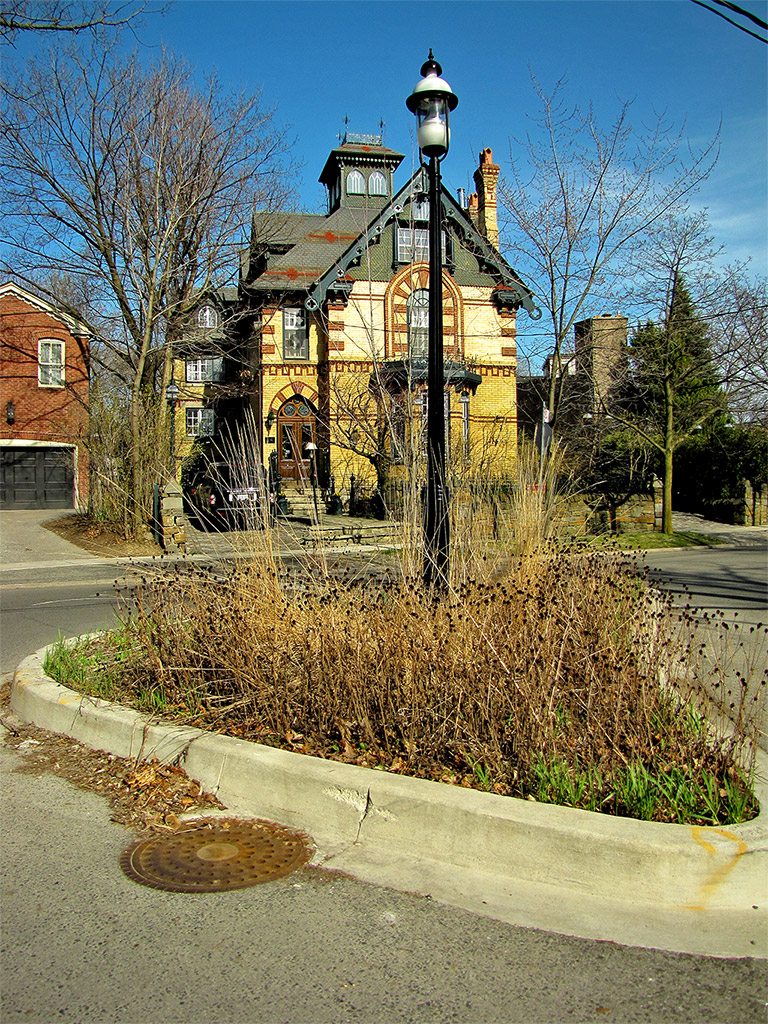
I hope I haven’t misled you, dear reader. As the name implies, Rosedale isn’t all weird and unusual structures. The common Meadow Rose is rumoured to still spring up there, if that’s any indication of the place’s frilly beginnings. Probably still some growing around some of the older buildings. A testament to the fact that some of those buildings have been around since Rosedale got the name.

rosedale, roundabout, intersection, historic house, toronto, city, life

Back in the day, the community was thought to be waaaay out in the sticks. Maids wouldn’t travel out there so people didn’t want to buy houses for fear of  having to “rough” it. No shit. And there were some interesting goings-on too, like the disappearance of Ambrose Small in 1919, just after he’d sold all his theatre properties for $1.7 mill. Lots of suspicion on the wife, one of Small’s employees makes off with $100,000; sounds like good Sunday afternoon reading. Doesn’t Rosedale seem like a good setting for it?

rosedale, historic house, flower, bloom, bud, toronto, city, life

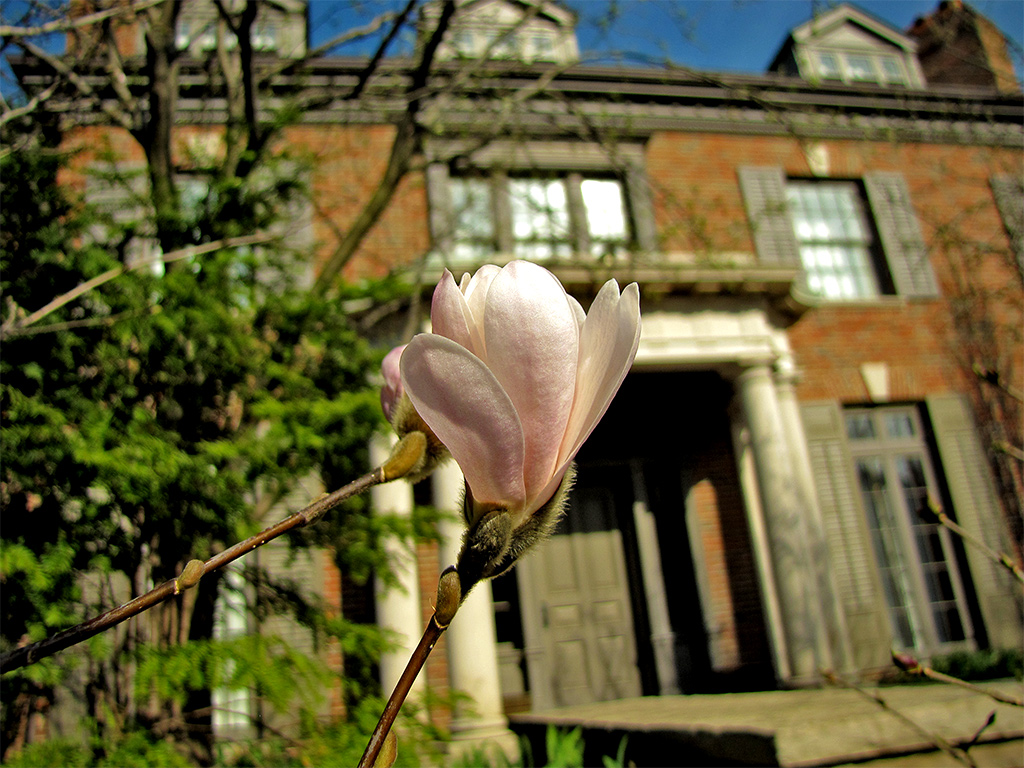
Also there’s the story of Bill Bull, a prolifically ironic writer on church history, who in ‘31 had Al Capone trying to kill him. Hey, no one ever said that all the neighbourhood money was legit, did they? It certainly would explain why all the buildings have such imposing facades too. Plenty of spots for snipers to sit in wait for assassins. I wouldn’t be surprised to hear that moats had once existed around some of these homes.

… Continue Reading

Filed under: B Sides, Pictures

Air conditioning for garden sheds, pt.2

Posted on April 8th, 2010 5 Comments

…continued from previous part.

Industrial design has been a monkey on my back ever since I picked up the habit about eight years ago. My misbegotten aim was simply to learn about design – to get better at my Flash stuff. But, as was foreseeable, I got sidetracked. Into the industrial aspect; you know, design for mass production.

The movement started some time in in the early 1900s when factory production for most domestic items became widely available. They’d started to do weird stuff with wood and plastics were making a splash. But design still had much of an influence, despite the shared credo of “form follows function”. In fact, industrial designers concerned themselves more with the practicality of appearance than function most of the time; function was left to the engineers.

This extended to architecture too.

There are, of course, nasty leftovers from industrialization. Environment / people / health problems aside, many manufacturers took the opportunity to cut out the designer and head directly for cheaper products which has caused the epidemic of poorly-produced / copied domestic items we see today. If it wasn’t for stores like Ikea, we’d never know who was responsible for coming up with the objects sitting on our kitchen table. Or the kitchen table itself.

But I think the spirit of that earlier era still lives in architecture, and in places like Rosedale. Mostly because industrial design always came across as generally domestically oriented that I find it most obvious here. People in the area generally have the money to dabble with and buildings tend to last longer.
rosedale, industrial design, architecture, toronto, city, life

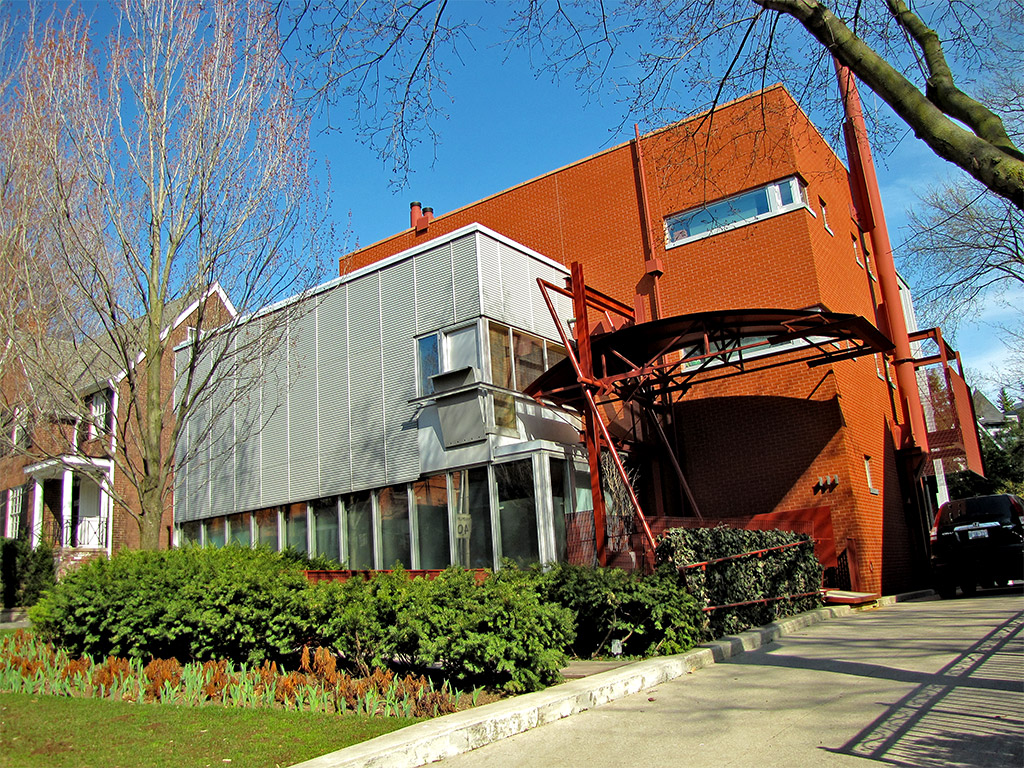
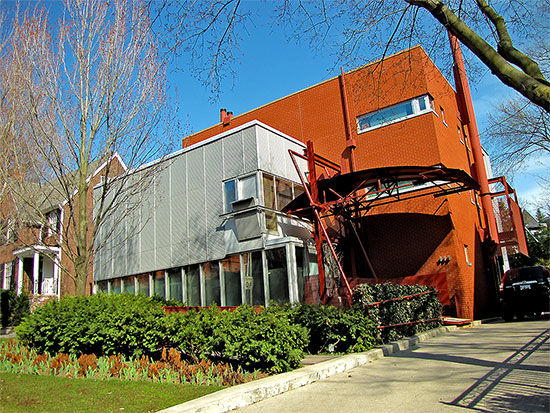
The fad in industrial design, at least initially, was to combine basic geometric shapes to produce interesting everyday objects (i.e. simple geometry=simple / mass construction). To me, the house above looks like an architectural draft, all linear and arcy. Note the simplicity of the form and the commonality of the building materials. Very industrial design. Here’s another Rosedale example:
rosedale, industrial design, architecture, toronto, city, life

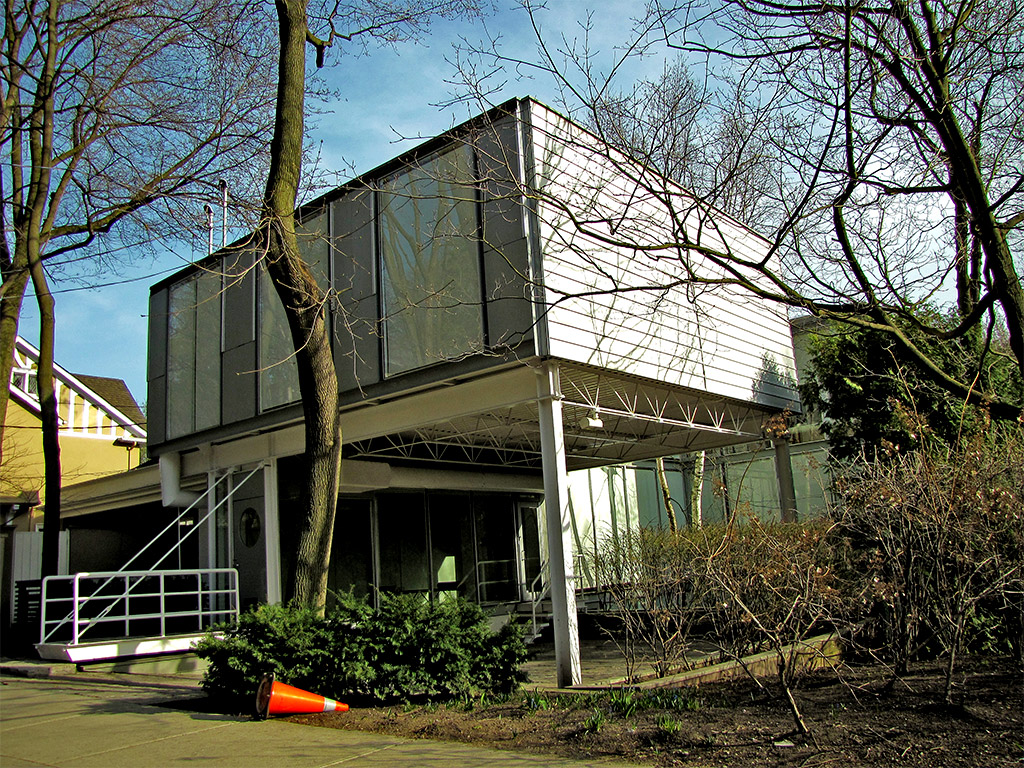
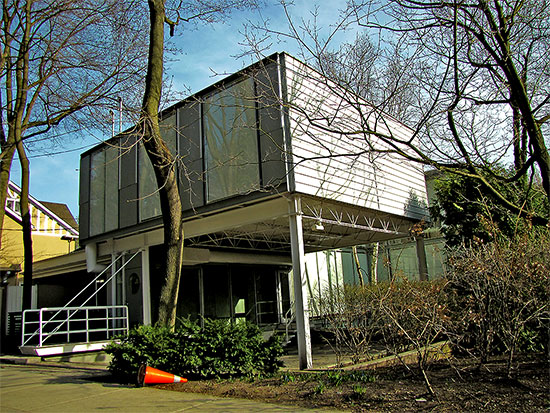
Looks like a garage from a Lexus commercial, doesn’t it? Guess they have to shoot ’em somewhere. Not the kind of place I’d be keen to live in, but I’m glad someone does. :)

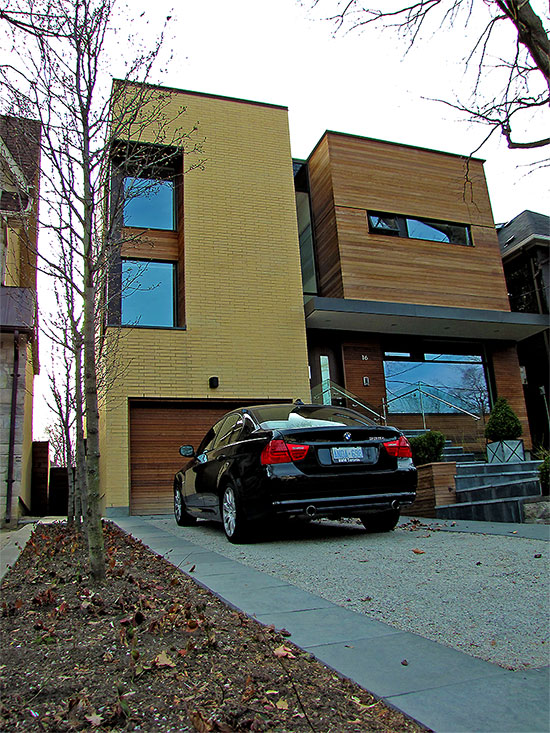
If I had to pick one of the more modern Rosedale houses to live in I’d veer more toward the homes that depend on a variety of materials rather than unusual structural shapes. Seems like they’d be more comfortable:
rosedale, industrial design, architecture, toronto, city, life

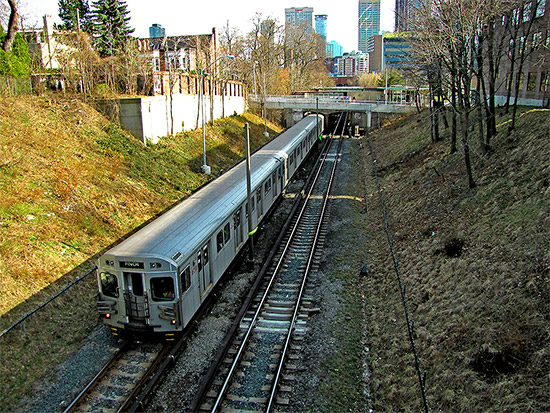
Rosedale  is quiet, and chock-a-block with flowers and people with too much time / money on their hands. And being just north of money-laden Yorkville, it’s essentially a part of downtown Toronto. If they weren’t all driving fancy talking cars, Rosedale residents could take the subway if they wanted to.
yonge, subway, trains, ttc, toronto transit commission, underground, toronto, city, life

Continued in next part…

Filed under: B Sides, Pictures