
Posts Tagged ‘ media ’

Mr. Gorbachev, bring down this wall!

Posted on September 25th, 2013 2 Comments

You may have heard the term “paywall” — it’s when a web site limits the amount of content that you can see unless you sign up with them for a fee. This typically happens after you’ve viewed a predetermined number of articles, and that number is reset on a daily, weekly, or monthly basis (depending on their setup).

All of Toronto’s major daily newspapers have put up paywalls, including the Toronto Star, Toronto Sun, Globe and Mail, and National Post.

And they’re all just awful.

Much hooplah was made about a developer that bypassed the New York Times paywall a couple of years ago, yet little (if anything), has changed since. David Hayes, the developer who cracked the NYT paywall, claims it took him a lunch hour to write the bookmarklet that bypasses the newspaper’s paywall.

A couple of days ago when Sarah was hitting the Star’s paywall I decided to take a quick look at what would be involved in getting around it. Twenty minuted later I had bypassed the paywalls of all of the above papers, including the New York Times (before I’d read anything on the topic, I should add). It took another 30 minutes to produce a small, generic site script that makes the dewalling process just a little easier and faster.

I’m not blowing my own horn here. I’m no super genius and this “hack” could be accomplished by anyone with rudimentary web development experience. In fact, both Hayes’ code and my own are almost unnecessary; with a few extra steps, you can bypass these paywalls with no extra software or crazy hacking skills. Chances are good that you already know how to do it.

I can see some extra benefit to a utility that would assist in automatically navigating the paywall beyond the first article — so that you could click on the web page links instead of having to load article by article — but this was more of a proof-of-concept thing, and the proven concept is that paywalls are unfortunately simple to defeat.

I’m not currently posting my dewalling code publicly. However, I will detail why this problem exists, and what the papers can do to fix it (if you’re from any of the aforementioned newspapers, feel free to give me a shout).

So Why Are Developers So Dumb?

I don’t think they are :) And to be honest, I totally get why things were done this way.

When a typical web browser grabs the web page you request, it sends out some limited information for the listening web server on the other end. This includes listing the browser’s capabilities (what kinds of content it can handle), specifying what it’s looking for (usually the URL of the web page), and cookies.

The receiving web server has that, plus an IP address, to identify an individual reader over the internet.

The IP isn’t unique to you, it’s unique to your internet connection which may be shared by many devices (like the the internet box thing, a.k.a. residential router, in your home). Browser capabilities can’t be assumed to be unique, again, because of that shared internet connection thing. And cookies can be cleared with the click of a button.

Given these limitations, how are web developers supposed to identify unique readers while ensuring that other legitimate readers can still access the site?

Better to err on the side of caution and just use cookies, sometimes along with IP, rather than accidentally block readers. Paywalls are necessarily leaky.

So What Should They Do?

This is a tough one.

It’s tough because it puts the limitations of technology up against corporate culture and profits.

What this does is really call up the need for reflection on how the papers profit from their content, and to me it’s an all-or-nothing proposition.

One option is for the papers go all-in and make certain articles, sections, features, etc. fully pay-only. That means having to log in to access them, otherwise it’s an excerpt, or some sort of teaser, to the general hoi poloi.

Another, more Zuckerbergian option is to offer access in exchange for personal information. I’m not necessarily averse to this, but it also requires a content lock-down of some sort.

The current paywall solution is somewhere just above both of these, being easily circumventable but still acting as a deterrent to the average web user.

I would gravitate towards the nothing end of the scale with a nag solution where on every X views of an article, the non-subscribed reader receives a temporary pop-over message suggesting that they subscribe. IP address on the server could be used to determine how often to do this — it seems unlikely that shared connections would all be connecting to the same content source, and even so, all it would produce is a nagging reminder that people really do like the content. It’d be sort of like a local rating system with an option to subscribe.

Beyond that, there could be a mild nag every time, for non-subscribed users. This starts to get close to being just plain old fashioned inline advertising, which would be the next solution before nothing at all (full, free access to everything).

Of course, since the papers have full control over their sites, there’s theoretically no limit on how inline advertising could be accomplished. There’s the always classy Toronto Sun wall-to-wall background…

sun_bg

…but if that’s not the newspaper’s style, I’m sure there are other and more elegant approaches.

Ultimately, the decision is whether or not to lock away content. Logins are reliable, which is why they’re so popular. Identifying users without them is inherently unreliable. Either content can be locked away completely, or it should be assumed to be open to everyone. The seemingly in-between paywall solution is actually in the second family by reasons which I’ve explained earlier.

Astute web developers will point out that other mechanisms are available to bypass some of these limitations: Flash shared objects, or persistent browser databases. While these are a step beyond simple cookies, both are easily deleted as part of most modern browers’ cache management. In other words, they’re not much better than anything mentioned so far.

Browsers impose these limits to provide a level of privacy protection, and without requiring readers to manually enter additional information like a username and password, it’s tough if not impossible to pinpoint an individual human being. Without this exactness, any paywall or content blocking system is bound to be flimsy. The solution, at least at the present time, won’t involve technology; it’ll require high-level decisions about what will be locked away from the general public and what won’t.

Filed under: Dispatches, Patrick Bay, Pictures

Did it just get ornery in here?

Posted on June 14th, 2013 Comments Off on Did it just get ornery in here?

Robbie’s having a rough day. Maybe it has something to do with that pesky crack tape that just won’t seem to go away. Maybe it’s because he just can’t make any friends.

“I don’t care if you’re 2 years old, 20 years old or 200 years old, you’re not going to live for free,” Ford said. Of TCHC chief executive Gene Jones, he said, “Obviously he has fixed the problem. Is it perfect? No.” Turning to a left-leaning critic, he yelled, “You! You’re the problem!”

Filed under: Dispatches, Patrick Bay

Worthington’s final words

Posted on May 14th, 2013 Comments Off on Worthington’s final words

I found it interesting to read what Peter Worthington’s final thoughts were about the paper he helped to found in his auto-obituary:

Of course, there is the Toronto Sun, which was never as good a newspaper as it could have been, but which was always a fun place to work, with good people who seemed to be forever being replaced by other good people.

The Sun was always pretty tolerant of me and, I must say, I was pretty tolerant of it from time to time. We both served each other’s purpose.

Not great, high turnover, and a necessary evil — or am I reading that wrong?

Filed under: Dispatches, Patrick Bay

Star complaint against Ford tossed by Integrity Commissioner

Posted on March 28th, 2013 1 Comment

It’s been almost a year since I reached out to the Star to see what was happening with their complaint against the mayor. You may not remember it — it had to do with how Ford was excluding media from City Hall (and especially the Star).

Well, the much-maligned Integrity Commissioner recently released her report on the incident and decided that there was nothing to follow up on. In other words, case closed.

Unsurprisingly, no one from the Ford camp is so much as mentioning the decision. I suppose it must be a foregone conclusion now that Rob Ford gets away with breaking every rule and law out there, why should this be any different? And, of course, further discussions about the balance in the office of the Integrity Commissioner are completely absent. In other words, if she’s questioning the mayor and doing her job, then of course she’s irrelevant, biased, and just the scum of the earth. If she’s siding with him, it can be ignored so that she can continue to be demonized.

But let’s put this to the side for moment and see what the report actually said. First, some history.

In February 2011, members of the City Hall press gallery put together a brief note stating what they expected of the mayor as a public servant:

The Gallery expects that all of its members will be treated equally and fairly. As such, all media releases, circulars, agendas, notice of scrums and other events, and other official communications from the City of Toronto, including the mayor’s office, must be communicated equally to all members of the Gallery, without favour or prejudice.

Ford ignored this and didn’t respond (surprise!)

In December of that year, a formal complaint was filed and, indeed, Rob Ford was once again found to have been doing exactly what he’d been accused of doing:

The complainant provided examples of bulk distribution of news releases and statements made by the Mayor to the media that were not given to journalists writing for the Toronto Star. The Mayor acknowledges that these were not delivered to writers for the Toronto Star. A search conducted of press releases from the Office of the Mayor during the relevant time period identified the recipients.

Additionally:

The former Press Secretary for the Mayor confirmed that after taking office the Mayor’s flatly stated position was, “I do not talk to the Star.”

Furthermore:

One journalist for the Toronto Star described the situation as an “underground economy” in information. Material was often provided on an “off the record” basis. Another journalist from the Toronto Star described the relationship-building with the Mayor’s Press Secretary as a “long hard slog” which improved over time.

And just to clarify:

The subject of the Mayor’s relationship to the media was discussed with many of those interviewed in this investigation. Staff members from the Toronto Star spoke about the difficulty of doing their work without up to date information about the Mayor and his activities. This complaint was not limited to the Toronto Star. Other journalists described the flow of information out of the Mayor’s office in these terms:

  • “few and far between”
  • “we aren’t kept up to date regarding what he is doing”
  • “occasional” statements
  • “less than once per week and sometimes once per month”
  • “It is not as if we have a direct line to the Mayor”
  • The Press Secretary is “inconsistent” in responding to journalists

On the continuum of “sparse or sparser” access, members of the Press Gallery said that the Toronto Star has less access than others. The media members interviewed, and those who commented publicly on the issue have said a number of times that a Mayor should be even-handed with the press and treat all outlets “fairly.” Others felt strongly that there is a democratic obligation on the part of elected officials to be open with the press and to be fair in access to information about their activities.

In the end and despite this overwhelming evidence, the Integrity Commissioner ruled in favour of Ford:

I conclude that on the particular facts in this case, there was no breach of the Code of Conduct by Mayor Ford. The reasons for this finding can be summarized as follows:

  • There is an accepted practice of elected officials, including the Mayor, determining how and when they will grant access to the media, by way of interviews, answering questions during scrums or providing information about their views, outside of the formal and publicly accessible mechanisms that exist for ensuring transparent municipal democracy;
  • The Mayor did not interfere with the access of Toronto Star reporters to significant avenues of information about the workings and agendas of City Council, the public service, or other councillors;
  • The City of Toronto has an open access policy for disseminating information to the media and to the public;
  • The Mayor’s personal policy of “not talking to the Star” was incomplete, with his knowledge and approval, as shown by the following:
    • distribution of some bulk e mails to thestar.ca;
    • distribution of most bulk e mails to other members of the Star Media Group, all falling under the direct supervision of the Publisher of the Toronto Star;
    • distribution of all bulk e mails to the affiliated sister company of Metroland;
    • the unofficial and multiple “work arounds” by staff and Toronto Star journalists, known, tolerated and cited by the Mayor in his defence.
    • The originating story which led to the Mayor’s reason for not speaking to the Toronto Star was written during a political campaign and was newsworthy because of his status as a public and political figure;
    • The ability of the press to publish, comment and otherwise hold politicians to account for their media communications practices.

So once again, Rob Ford smugly walks away from the fray because there’s really nothing in place to hold him to account.

Filed under: B Sides, Patrick Bay

City Hall banning press? Free speech?

Posted on September 16th, 2011 3 Comments

An astute twiterrer noticed a motion by Councillor Adam Vaughan to not ban press or journalists from City Hall. The full text of the motion reads:

No media conference, no media event or news release by The City of Toronto and/or any agency, board or commission of the City, and/or any staff, hired consultant or elected official of the City of Toronto shall exclude by name any individual journalist or news organization.

The twiterrer in question alludes to this “ban” referring to the Toronto Star which has been quite critical of Mayor Rob Ford — as have many people and organizations. And Robbie doesn’t hide his disdain for the paper so this is certainly believable.

Here’s what I find extremely troubling; freedom of press and freedom of expression are ensconced in the Canadian Charter of Rights and Freedoms [section 2 (6)]. For Councillor Vaughan to have to pass a motion to guarantee this freedom at City Hall suggests a very troubling trend of silencing dissent, criticism, and opinions that are not directly shared by Ford and his cronies.

If this motion does indeed turn out to be a response to Ford’s attempt to exclude the Star from reporting on City Hall, his claim that the paper is “openly working against the democractic process” would be beyond hypocritical. Criminal, even. And again, this isn’t unimaginable — Ford has been accused of backroom dealings in things like the Port Lands redevelopment project; even some of his hand-picked Executive Committee are distancing themselves because of the public outcry.

The vote on this motion is supposed to take place next week on September 21 and 22. I’m sure many Torontonians would love to hear the details of why Vaughan thought it was necessary to make the motion. It may turn out to be a simple case of political grandstanding so passing judgement is definitely premature. However, I wouldn’t put it past Robbie to be trying to silence his critics, and if this is the case then we’ve got a serious problem at City Hall.

Filed under: Patrick Bay, Why I'm Right

Toronto coppers go social

Posted on July 27th, 2011 Comments Off on Toronto coppers go social

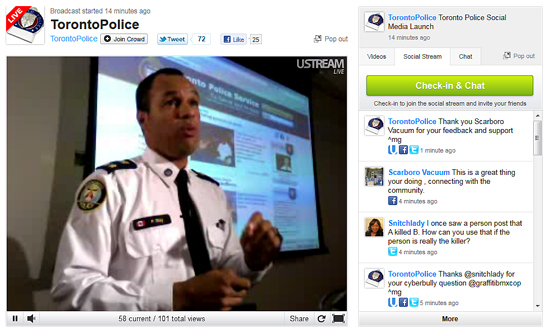
The Toronto Police Service launched their social media initiative this afternoon with a live presentation from Deputy Chief Peter Sloly.

peter sloly, deputy chief, toronto police service, toronto, city, life, blog

In a nutshell, they’ve put  / will put a few services online that were traditional in-person — background checks and such — but mostly the announcement was about the TPS’ now-official use of social media like Twitter, Facebook, and YouTube.

Chief Bill Blair was a bit more detailed:

Despite having more people on the force with Twitter accounts that you can follow, the police are still saying that you have to call 911 for emergencies or get a hold of a specific division if you have less serious stuff to talk about, but this will allow you to follow what cops are doing on the streets as well as giving you a more direct channel for general questions. I’ve chatted with a few of them via Twitter over the past year and they definitely are approachable (and they respond!), so that could work out real well in the community relations department.

The only concern I’d toss out there is in seeing these new channels become saturated and eventually becoming stagnant as responding to everything becomes impossible (you can see this with very popular Twitter accounts). Guess only time will show how prepared the TPS is for this possibility.

Filed under: Dispatches, Patrick Bay, Pictures, Videos

Fiery Brazil

Posted on April 17th, 2009 Comments Off on Fiery Brazil

Even on a day when the temperature eventually touches the nicer end of twenty degrees Celsius (sixty-eight  Fahrenheit), it’s still possible to dress inappropriately. For example, dressing in nothing more than green-white-yellow boxers (don’t care what you say, those are not shorts), and miniscule t-shirt turned out to be a poor decision by the young man shivering on the subway.

There was a wee nip in the morning and, without exception, everyone else was dressed so as to retain some body heat. He was, as I could gather from the small logo on the sleeve of his t-shirt, a cadet of some sort. Sure, you gotta be a bit tougher for that kind of thing, but I hope that some wisdom intercedes before he’s given a firearm. He looked absolutely frigid, huddled in a small, pale mass on the subway bench next to a svelte woman twice his size.

He was, basically, really tiny and really cold.

The only other reason I could see for someone being so wholly under-dressed would be if they had just returned from vacation. You’ve seen them: doe-eyed sadness, brown and suddenly stripped of the sun by a bitter northerly wind raking their naked skin as they step through the terminal exit. Genuinely amusing; but I can appreciate the more relaxed attitude. Unless they were returning from one of those Conquest vacations. In that case, the blazing inferno of their concentrated displeasure would probably sear a hole in the side of the plane.

Imagine going south with your family after pinching pennies for a year only to discover that the company you had booked with went tits-up while you were sipping Pina Coladas. That, in and of itself, wouldn’t be the real pisser though. What would light your fire would be the fact that you might have had to pay for the remainder of your vacation, and your trip home, out of pocket. Or else.

So, where did the money go? I mean, last time I booked a vacation I had to pay for the full thing before I was given the flight tickets, and it sure as hell wasn’t cheap. In other words, I had already paid for my vacation. So imagine my surprise if I ended up in Cancun only to find out that, in fact, no I hadn’t. Except I had. Meaning, somebody stole my money. If it was a matter of bad credit between businesses then trying to shake down the customers to try to get it back is a theft on both fronts. Is it any more complicated than that?

The moment my feet hit Canadian soil, I would be exceedingly and most exceptionally pissed. Until then, I’d be high-tailin’ it through the jungle like a greased monkey. I’d probably discover later that I’d hurt myself real bad during my coca-fueled flight, but I would make it to a road. There I would swap English lessons and charm for rides, putting increasingly happy miles between the hotel and me. Thus, riding a crest of elation, I would find myself not north as I had expected, but south — in Brazil. Fiery Brazil.

So…I hope that the tourists who got the royal shaft from Conquest will be doing that when they get home because, frankly, I haven’t heard a single critical note on Conquest pipe put of any of the local media. Where are the kick-ass take-downs? Where are the public photos of Conquest execs hanging their heads in shame for absconding with their customers’ money?

That’s right, I’m asking for poo to be flung.

Customers who have booked a Conquest vacation will likely get the money back.” – *sob*

Oasis [resort] staff told the 200-odd guests who booked through Conquest they must pay the $1,078-per-person bill – or police would come to the airport the day of their scheduled departure and force them to clear their tab.” – Ouch.

Conquest Vacations regrets the inconvenience caused to the passengers due to cessation of its operations” – !

Canadians clashed with Mexican hotel security guards Thursday when a group of 28 people staying at the Golden Parnassus resort tried to leave the premises after disputing their bill, according to one of the travellers.” – Image, gone.

At home, Conquest’s sudden demise is raising questions about the travel-industry watchdog’s role in preventing such inconveniences.” – You know, that is inconvenient.

As a gesture of goodwill, we are offering travellers who are rebooking their vacations with Sunquest over the next 10 days $100 off the lowest current Sunquest rates — with proof of their Conquest Vacations purchase” – Turning frowns upside-down.

In business since 1972, Conquest served destinations in Canada, the United States, the Caribbean, Mexico and Europe.” – Good to know. Good to know.

Beaver had recently planned a trip to the Dominican with her boyfriend.” – I’m so so sorry. I just couldn’t stop myself. It was automatic – like clicking in a dream.

Filed under: Why I'm Right