Posted on
October 3rd, 2015
–
Comments Off on “Rule of Law” … LOL
“Health colleges routinely cut deals to shorten suspensions for members caught making fake billings if certain conditions are met, the Star found.
These conditions include ethics and accounting courses, remedial training and requiring the health professional to pay the college’s costs in building the discipline case.
Most professionals disciplined for false or misleading billing were allowed to continue practising after a suspension ranging anywhere from one month to 18 months.
…
107: number of health-care professionals found guilty of false or misleading billing
99: number of suspensions issued to health-care providers for false or misleading billing
7: number of licences revoked for false or misleading billing”
“In the last five years, nearly 350 officers from police services in the Greater Toronto Area — Toronto, Peel, York, Halton and Durham — and the OPP have been disciplined for what their own services call “serious” misconduct, a Star investigation has found.
Roughly one in five of those officers was disciplined because he or she had been found guilty of criminal offences, including assaulting his or her spouse, drunk driving, possessing drugs and theft.
Nearly 50 of the officers were disciplined more than once; some were nailed for new offences just months after being penalized for past misconduct. One officer was busted for being drunk behind the wheel twice in one week.
Someone with a criminal record would almost never be hired as a cop. But many cops who are convicted of criminal offences are allowed to keep working. Only seven police officers were successfully forced out of their jobs.
…
Most police discipline cases don’t get reported beyond station walls.
In decision after decision, the officers presiding over the case — the judges — remark how media coverage of the officer’s misconduct would undermine public trust in the police.”
“According to officials at the ministry of public safety, which releases the report each year on RCMP’s crimes, most of the laws are broken during undercover operations.
The police immunity stems from a 1999 Supreme Court ruling that found that while police officers are not immune from criminal liability, Parliament could decide on some immunity if it were in the “public interest.”
In 2003, Parliament tabled an amendment to the criminal code that allowed officers and agents to break laws – with permission – on the condition the acts “were subject to a legal requirement of reasonableness and proportionality,” the 2012 report said.
In addition to the RCMP, the law breaking privileges extend to customs officers and immigration officers.”
Posted on
October 3rd, 2015
–
Comments Off on “Democracy” … LOL
“…there was no chance for public input before rookie Councillor Justin Di Ciano proposed that Toronto reverse its stand. The motion, part of debate on proposed changes to the City of Toronto Act, passed 25-18, with the support of seven councillors who reversed their earlier support for ranked ballots.
…
Under ranked ballots, a candidate with a majority of first-place votes — 50 per cent plus one — wins, just as in the current system. If nobody meets that threshold, the candidate with the fewest first-place votes is knocked out. The second-place choices of that candidate’s supporters are added to the totals of the remaining hopefuls, and so on, until somebody has a majority.
“The way it happened was entirely undemocratic; it really feels underhanded,” said Katherine Skene, of Ranked Ballot Initiative. “But we’re hopeful that there is still the possibility for change.””
“The federal government and the provincial and territorial governments all have laws that provide rights and freedoms: laws against discrimination in employment and accommodation, consumer protection laws, environmental laws and, in the area of criminal law, laws that give rights to witnesses, victims and persons accused of crimes, to name only a few.
…
Section 1 of the Charter says that governments may limit Charter rights so long as those limits are ones that a free and democratic society would accept as reasonable*. It is also possible for governments to pass laws that take away some rights under the Charter. Under section 33 of the Charter (sometimes called the “notwithstanding clause”), Parliament or a legislature can make a particular law exempt from certain sections of the Charter – the fundamental freedoms (in section 2), the legal rights (in sections 7 to 14) and the equality rights (in section 15).”
* – Do you remember the “democratic” vote that took place for this? And exactly how “free” are Canadians when they need to be “granted” rights and freedoms, need to ask government for permission to marry someone, may not ingest anything that government doesn’t allow, do anything to their bodies that’s not government approved, are indebted to the government for their entire lives (and beyond) based on some non-existent “social contract” that they implicitly agreed to the moment that they popped out of the womb, and so on?
“…I also had visions of a Hindenburg-like execution that, on top of stretching the project out to a future when the apes have taken over, includes cost overruns that are certain to result in another new tax.”
“Renovations to Toronto’s Union Station will not be completed until 2017 at the earliest – two years behind schedule and $160-million over the original budget.
The city’s government management committee met Monday to approve an additional $4-million for the project, bringing the total cost of the renovations to $800-million – up from its original $640-million price-tag. And the project, originally expected to reach “substantial completion” in 2015, now won’t be ready until 2017.”
A lot cheaper than it could be since they’re spending $0 on accountability or oversight.
The RCMP will receive $150.4 million in new money over five years, beginning in 2015-16, and $46.8 million a year after, with the money going to help the Mounties conduct terrorism-related criminal investigations.
The border-services agency will get $5.4 million over five years and $1.1 million annually in subsequent years, with some of the funds earmarked for identifying high-risk travellers.
…
“The reason the international community has intervened in Iraq is the serious threat that ISIS poses . . . . We’ve had some successes, but, at the same time, it is no secret this is an ongoing battle. This organization poses a great threat and continues to pose a great threat, obviously, to security in Iraq and Syria.
Posted on
May 22nd, 2015
–
Comments Off on “…no right to a jury roll of a particular composition”
Clifford Kokopenace, an aboriginal man from the Grassy Narrows reserve, was convicted of manslaughter in the 2007 death of Taylor Assin. Before sentencing, his lawyers learned that the roll from which jurors were selected consisted of 699 potential jurors, of whom only 29 were First Nation on-reserve residents — about 4.1 per cent.
But in that district, on-reserve residents made up 32 per cent of the adult population. Kokopenace’s lawyers argued his Charter rights to a fair and impartial jury were violated. Ontario’s Court of Appeal agreed.
In a 5-2 decision written by Justice Michael Moldaver, the Supreme Court ruled an accused’s right to a representative jury is “not the appropriate mechanism for repairing the damaged relationship between particular societal groups and our criminal justice system.”
The court said there is no right to a jury roll of a particular composition, nor to one that proportionately represents all the diverse groups in Canada. The court found that when Kenora’s 2008 jury roll was formed, Ontario’s efforts to include aboriginal on-reserve residents in the process were “reasonable.”
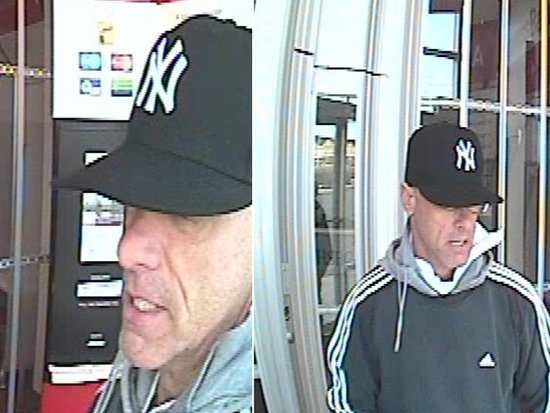
On Friday, York Regional Police and Peel Regional Police and the Canadian Bankers Association plan to hold a news conference in Aurora to publicize the $100,000 reward.
The robber is known at the Vaulter Bandit for the way in which he jumps over the counter during robberies, and he has been linked to about 20 bank heists over a five-year period across Canada.
Posted on
May 15th, 2015
–
Comments Off on “advocacy groups that encourage boycotts of Israel … the new face of anti-Semitism”
The Harper government is signalling its intention to use hate crime laws against Canadian advocacy groups that encourage boycotts of Israel.
…
The government’s intention was made clear in a response to inquiries from CBC News about statements by federal ministers of a “zero tolerance” approach to groups participating in a loose coalition called Boycott, Divest and Sanction (BDS), which was begun in 2006 at the request of Palestinian non-governmental organizations.
Asked to explain what zero tolerance means, and what is being done to enforce it, a spokesperson for Public Safety Minister Steven Blaney replied, four days later, with a detailed list of Canada’s updated hate laws, noting that Canada has one of the most comprehensive sets of such laws “anywhere in the world.”
…
In January, Canada’s then foreign affairs minister, John Baird, signed a “memorandum of understanding” with Israeli authorities in Jerusalem, pledging to combat BDS.
It described the movement as “the new face of anti-Semitism.”
A few days later, at the UN, Canadian Public Security Minister Steven Blaney went much further.
He conflated boycotts of Israel with anti-Semitic hate speech and violence, including the deadly attacks that had just taken place in Paris on the Charlie Hebdo magazine and a kosher supermarket.
Blaney then said the government is taking a “zero tolerance” approach to BDS.
…
“We’ve asked our lawyers. What does that mean?” says CUPE president Paul Moist. “Is it now a criminal offence to walk around with a sign saying close all the settlements, Israel out of occupied territories?”
In France, the law has for years criminalized hate speech based on national origin, and authorities there have in recent years been using it to prosecute BDS advocates. To date, more than 20 have been convicted.






 ... with pictures
 ... with sounds
 ... with videos
 ... with opinions
 ... that's shorter
 ... that's longer
