breakfast
Posted on February 26th, 2026 – Comments Off on breakfast
A Cooper’s hawk perched outside the living room window and finishing off his meal (another bird). Personally, I prefer to start my day off with a coffee.



A Cooper’s hawk perched outside the living room window and finishing off his meal (another bird). Personally, I prefer to start my day off with a coffee.
We seem to be approaching the 6-month mark since the previous installment so, ladies and gentlemen, without further adieu I bring you a bespoke version of the most elegant:

Despite its obvious advances in everything from fashion to medicine, one may perhaps be tempted to dismiss the Toronto of over a hundred years ago as an inconsequential anachronism in the context of the modern metropolis. For example, one may point to the seemingly ubiquitous springtime intestinal troubles experienced by locals, as evidenced by the apparent popularity of certain products that appeared in advertisements of the period.



Pish posh, I say! Can one honestly claim that we don’t have to deal with different types of shit in Toronto every season?
Besides, perhaps their physical ailments were related to the introduction of inferior arsenic and strychnine into various products, or perhaps the complete absence of such healthifying ingredients in fake products (shame on the flim-flammers!), but I’m certainly no doctor so we can just go ahead and file that under “speculation”. Moreover, such an analysis fails to take into consideration the countering health benefits provided by certain yeasty tablets which, along with vitamins A, B, C, and calcium, contained only the finest and most refined naturally occurring strychnine.

There are, it must be said, many traditional concepts that we should like to dispense with but that have held through to the modern era due to their enduring aptness. Is it for me to say that they’re wrong?
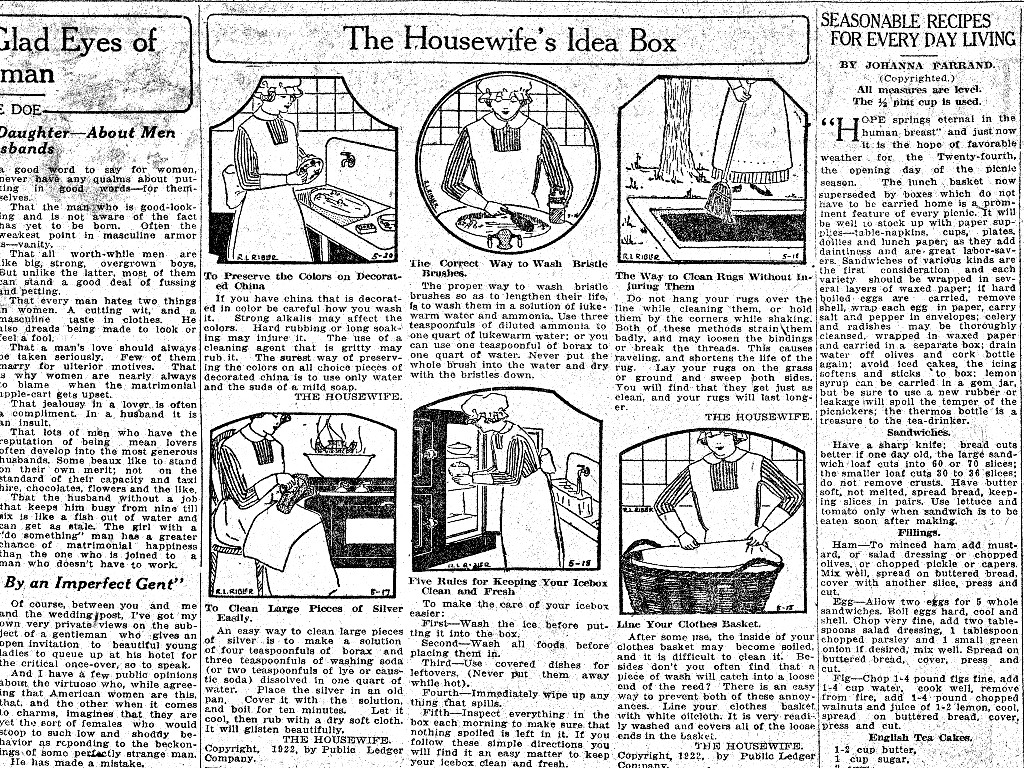
Why, even non-scientific, which is to say artistic, endeavours from bygone years have stood the test of time. Should I claim that my tastes in decorative motifs are the sole and correct ones?

It’s precisely for these reasons that one should occasionally glance to the past and say, “Gee whiz, that sure was something.”

tl;dr — the story’s far from over.
Long version — yup, it’s done.
Let me explain.
Technically, /sectionb was done well over a month ago but I wanted to give it one more thorough read/edit before officially calling it a day. I suspect that an error or incongruence or two snuck in regardless but, at this point, I’ll just have to live with it or them.
That being said, I welcome you to read the first /sectionb novel online but as someone who spends time ingesting content on an ageing offline tablet, I though it might be useful to produce a few offline versions as well. You can download them, in full and for free, here:
With my bona fides in place, I wish to assure you that the dedicated /sectionb website will continue to be a place to catch up on updates and to get extra content. I make no promises but as work on the second part continues, you may find some other there stuff too.
This is a bit of an exception from my usual posts but I thought I’d add it here since people seem to have been struggling with this for years and since you can presently get this hardware around Toronto for as low as $10.
I happen to have a Rogers-branded box but I suspect this method would work just as well for any other any other branded CGN3 models. It might even work with other branded Hitron networking devices but that’s a whole lotta conjecture on my part.
As mentioned, this simple bypass will only allow you to set up the CGN3 as a standalone router and assumes that you can’t log in to configure it for this purpose (otherwise just log in and configure it!) Usually this is because the device is brand-locked (e.g. to Rogers), and requires a confirmed cable internet connection before allowing you any further.
If you’re planning to use the router for cable internet access then you should go through the regular setup outlined by your ISP. If that doesn’t work then contact them for assistance (that’s what you’re paying for!)
Otherwise, use this method to connect your WiFi and wired devices together so that they can communicate. Typical uses include LAN gaming, connecting to local networked printers and scanners, using local webcams, accessing local network storage devices, local file sharing and media streaming, etc.
document.querySelector("#test").value = "1";
document.querySelector("#name").value = "";
document.querySelector("#pass").value = "";
initHistory();Again, it’s a cheap option if you’re looking for a wireless+wired router that supports 802.11b/g/n concurrent dual band (2.4GHz and 5GHz) along with WPA-PSK and WPA2-PSK security. It’s got pretty flexible configuration options and it can even act as a Samba (network) storage server — just plug a USB storage device or two in the back.
I can’t say that the CGN3 is the best router I’ve ever used but it works pretty well, most of the time. For the money, I can’t complain.
Here’s my remix of Brad Turcotte‘s (a.k.a. Brad Sucks) “Feel Free! Plastic Surgery!” from his 2012 album “Guess Who’s a Mess“. Brad’s track is awesome but it doesn’t match my musical sensibilities (abilities?) so you’ll find that it’s a bit of a departure from the original.
This tune is the first of what I hope will become a collection or album of some kind. The idea for the Boreds of Canada name can be heard near the end of my version of the song and, besides Brad, the ditty was loosely inspired by Doxent Zsimond’s “acoustic” rendition (quotes and their contents mine). Rest assured that as soon as I discover other Canadians worthy of my deft acoustic touch I’ll be adding them to the Boreds repertoire.
FEEL FREE! TO DOWNLOAD THE MP3!
(It’s licensed under Creative Commons)
There’s also an instrumental version
I’m not really big on end-of-year wrap-ups or retrospectives in general but I think it’s worth reviewing some of the things I’ve been following and projects I’ve worked on this year. By extension, I suspect that 2026 is going to be a busy year.
Although I haven’t matched the zeal of the blog’s first year it’s nice to note that as TCL heads into its 16th year it’s still going strong.
I know that the site’s stats are a minuscule drop in the ocean of modern internet traffic but it’s rewarding to note that TCL has a reach that is both global and for the most part organic, meaning that I spend exactly 0 minutes and $0 on promotion. By this mean I mean that I’m open to select and affordable promotions so reach out if you’re interested (see sidebar).
TCL readers may recall the SPI project. To wit, it’s an effort in which Toronto Police Service’s Calls-For/4-Service data is collected and analyzed over a multi-year period. Basically, any time the Toronto Police are dispatched to a call, whether valid or not, it appears in the C4S data.
Interesting patterns have emerged to my naked human eye and I suspect that subtler patterns may emerge to the digital eye. As an example, in the past I’d noted that the 12 overnight hours during Halloween seem like the busiest time for Toronto Police.
Do other interesting patterns exist within this data? Are there other observables that could be recorded and analyzed in a similar manner? 🤔Questions linger, efforts continue.
Now that we’re more-or-less living in cyberpunk land I thought it best to get in on the action. The early results of my experiments with generative AI were satisfactory but not always what I expected. However, the technology improved pretty quickly and I think I was just as astonished as most people by the human-like coherence of its output. We now have potential access to incredible tools with which to create realistic images, videos, sounds, and music.
I use the word “potential” because all these tools include some sorts of limits, primarily because they’re being hosted on remote servers by remote people living in remote realities. As usual, paywalls have been erected.
In response, I learned to adapt some of their stuff to my local, albeit limited, setup. The results make me wonder if we couldn’t cooperatively rent/borrow out our meager hardware (or rent/borrow out others’), in order to add to the parallelism of modern-day AI inference tasks.
Either way, AI has escaped the government-corporate sphere and is currently available to anyone who wants to avail themselves of its abilities. And now it’s agentic. How long the situation will last is anyone’s guess so, looking forward, I deeply recommend looking into it.
If you’re feeling a bit worn down by walking the “straight and narrow path on the tree-lined route, weakly lit by sparse and sickly yellow lights that barely hold back an encroaching darkness“, consider a slight detour.
The first full-length /sectionb novel is now complete, online, and publicly available. The follow-up is in the works.
Why did I make the first novel freely and fully available online? Simply, as many dope dealers will gladly explain, because “the first one’s free!”
I’m continually in the process of adding promotional material which you’re free to distribute to all your edgy friends, radical underground buddies, and any other easily malleable subjects that you may encounter.
Obviously this is heading somewhere so stay tuned in the new year!

Speaking of the new year, what would a year-end post be without a little analysis? I’ll leave out the obvious “rise of AI” obviousness and instead posit something large that no one yet seems to be mentioning.
While this is strictly speaking not Toronto-centric, am I the only one smelling the presence of global armed conflict? Ukraine may have been a hopeful NATO proxy for a while but it’s looking more like the masks are coming off (and true intentions are emerging).
For example, in Germany:
Germany will require all men to register for potential military service from 1 January 2026, with compulsory service to be reintroduced if volunteer numbers fall short of targets set to meet NATO commitments.
“Modern military service is coming,” said Jens Spahn, Chairman of the ruling CDU/CSU parliamentary group, in a press statement.
“We will have more commitment to voluntary service, the aim is to establish a binding growth path in law with a six-monthly reporting obligation to the German Bundestag.”
…and France:
French President Emmanuel Macron is widely expected to unveil a new proposal on reintroducing national military service on Thursday. During a visit to the 27th Mountain Infantry Brigade – one of France’s most elite military units – in the southeastern town of Varces earlier this week, the Élysée Palace said Macron would make an announcement that would “reaffirm the importance of preparing the nation and its morale to face growing threats”.
…and the UK (also Sweden, Norway and Denmark):
Prime Minister Rishi Sunak said he believed bringing back compulsory service across the UK would help foster the “national spirit” that emerged during the pandemic.
Labour criticised the plans, expected to cost about £2.5bn, as “desperate” and “unfunded”.
The Conservatives want the first teenagers to take part in a pilot from September 2025, with details to be worked out by a Royal Commission
The armed forces placements would allow young people to learn about cyber security, logistics, procurement, or civil response operations.
…and Poland:
Work is under way to make all men in Poland undergo military training, Prime Minister Donald Tusk said.
In a speech to the Polish parliament, Tusk said the government aimed to give full details in the coming months.
Efforts are being made to “prepare large-scale military training for every adult male in Poland,” he told the Sejm.
“We will try to have a model ready by the end of this year so that every adult male in Poland is trained in the event of war, so that this reserve is comparable and adequate to the potential threats.”
…and a few other countries:
In the past two weeks alone, Germany and France announced new schemes to enlist more young recruits into their armies.
Belgium also announced the reintroduction of a form of voluntary military service for all 18 year olds earlier this year, just as the Netherlands did in 2023.
Others, like Lithuania and Sweden, saw Russia’s seizure and illegal annexation of Crimea in 2014 as an early warning sign to beef up their armies, and reintroduced conscription soon after.
Although Canada has not (yet) made a similar announcement, a recent interview with Canada’s top brass suggests a similar direction, which is to say bellicose and anti-Russian:
I already have (provided) significant contributions to Ukraine. We can go up to 600 members.
What we want to do is have scalable options that dial up or down depending on the demand. And there are ways to rearrange current forces serving in Europe via the NATO stream.
I don’t believe you need to take any sides in this brewing conflict in order to see the pieces moving into position. In the mix is Russia’s stance on any enemy combatants that they may capture in their encounter with Ukraine:
Any Western troops deployed to Ukraine would either become legitimate targets for Russian forces while hostilities continue but deploying them would serve no purpose in the event of a peace deal, President Vladimir Putin said on Friday.
So if any of those “up to 600 [Canadian] members” are captured in the seemingly swelling conflict, would they be considered traditional prisoners of war? Considering that no declaration of war has been issued, and if some reports are to be believed, shit’s about to get messy for everyone. I doubt Toronto will be spared.
(From Toronto to Substack)

About a month ago IEEE Spectrum magazine published an online piece by Matthew Smith entitled “Your Laptop Isn’t Ready for LLMs. That’s about to change“
In the article Matthew laments that, “for the average laptop that’s over a year old, the number of useful AI models you can run locally on your PC is close to zero. This laptop might have a four- to eight-core processor (CPU), no dedicated graphics chip (GPU) or neural-processing unit (NPU), and 16 gigabytes of RAM, leaving it underpowered for LLMs.“
🤔 “That’s odd,” I thought to myself. “It sure seems like I’ve been using considerably more than ‘close to zero’ useful models on my setup.”
For comparison, I’m running a dual-core (multi-threaded) system with 128MB integrated Intel UHD graphics, definitely no NPU, and by modern standards a measly 8 gigs of RAM. The machine is about 3 years old and it was already a “budget-friendly” laptop back when I got it. As a gaming machine in 2004 it would’ve been pretty badass. Today, not so much.
Admittedly, most of the models I run locally are not (by modern standards) considered large but they’re pretty much on par for my daily needs. There appear to be a good variety of minimal desktop models to choose from and although they’re not all used for interactive chat, within my personally limited specs the number of choices is still quite large.
While Matthew makes mention of the Small Language Models that I employ, his only criticism is that these models “either scale back these features or omit them entirely“ without actually defining what “these features“ are (unless the ginormous size of LLMs is considered a “feature“?)
I’ll grant that generating responses on my hardware is noticeably slower than when using larger (remote) models but that just means that my (fully local) agentic sidekick needs to wake up a bit earlier in the morning in order to complete its high-priority tasks before my first coffee of the day. After that there are plenty of assignments that it can accomplish in the background while I finish another high-quality, fullscreen mission in “Psi-Ops: The Mindgate Conspiracy”.
All told, a 3-to-6 billion parameter model is probably the upper limit for my setup but even then I’ve got some great options like Google’s Gemma, Microsoft’s Phi, or Alibaba’s Qwen. All three come in a variety of quantized flavours that include thinking/reasoning and integrated software tool use.
If I want to use a model that’s not specifically trained for out-of-the-box tool use I can provide it with programmatic rules, not unlike how llama.cpp operates. Moreover, I can comfortably use these models concurrently with other, smaller, and more specialized models for tasks like computer vision, speech, etc.
Should I need to tighten my resource belt I can hot-swap down to slimmer language models like Liquid AI’s LFM or IBM’s Granite. Additionally, there are many derived and tweaked models available for deeply “underpowered” machines like mine.
Point being, I think that Mr. Smith got it wrong on this one. Laptops like mine are more than sufficient to run modern (albeit smaller), models. Even geriatric machines and browsers can contribute to the effort — depends on your requirements and your ability to split up the workload.
For example, there are certain tasks like generative image and video creation that my setup can’t reasonably handle but for these cases either me or my agentic buddy can farm the work out to a public interface like Google’s Colab.
There are limits, of course, but fully local agentic natural-language AI, as of late 2025, can definitely help with some of the day’s heavy lifting. In conclusion, Mr. Smith, I must judge your information to be a smidge out of date.
P.S. Regular TCL readers may recall a live example of how even browsers can run (very) limited models.
… in which the mercenaries are subdued, Section B et al. set out for a fateful rendezvous, and the first part of the story is concluded.

As I continue the struggle over the last few sentences of /sectionb (the struggle is real!) I thought I’d at least provide you with an interlude of the kind of music, other than my own, that has thus far fueled my writing. I consider this list incomplete and unordered but hopefully, in one context or another, it’ll all make sense.
Little Norway Park isn’t specifically what I had in mind when I was writing “Brush Pass” but it has a similar feel: damp, deserted, and seemingly benign — until it isn’t.

(larger)

(larger)

(larger)


 ... with pictures
 ... with sounds
 ... with videos
 ... with opinions
 ... that's shorter
 ... that's longer