Archive for the ‘ B Sides ’ Category

TOTALLY mental poker

Posted on September 19th, 2015 – 1 Comment

A few weeks ago when the HR lady called me and told me that I too was now among a number of people who had been laid off as a result of “business decisions”, I could scarcely contain my enthusiasm. “That’s great!”, I replied giddily. There was a moment of silence before I caught myself. “I mean, that sucks … terrible .. but it’s great that I know about it sooner rather than later”, I sputtered. Good save.

I clumsily explained that, having spoken to colleagues and being aware of the changes, I could now live without the uncertainty, then swung the conversation back around to me getting fired.

“Yeah, no, that’s bad news,” I assured her but added that the severance would be helpful.

I was lying – I was elated.

Thing is, I’d been working on a project in my spare time that it was probably best to keep hush-hush. So it was. The main complication was the fact that the project is an online poker game and I was – until recently – working for a company that had bought PokerStars. It wasn’t that I was “borrowing” code or secrets or clients or anything like that, and I genuinely liked working for them, it’s just that the whole situation felt complicated.
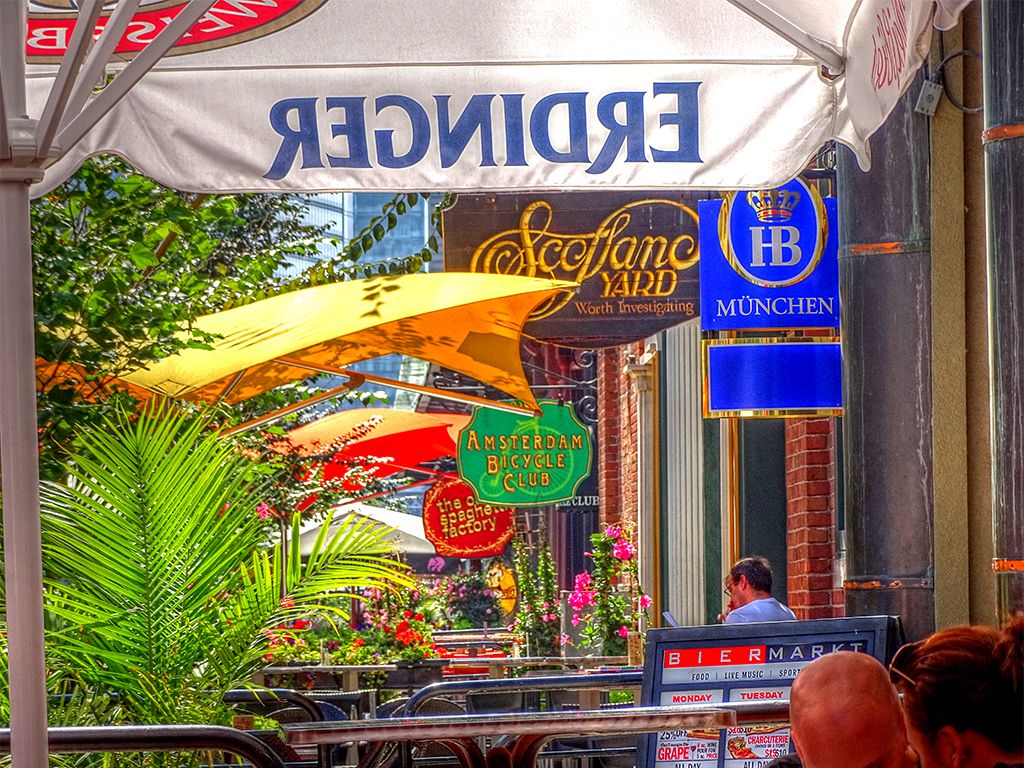
biermarkt on the esplanade

Besides I just thought that the idea was too damn good to risk any potential roadblocks, especially early on. So I assumed an alias and toned down my writing style.

I was asked why I included a cryptographic identity when I first announced the project on Reddit, and this is why. I was probably being a little too paranoid but so far everyone I’ve discussed it with thinks it’s a pretty darned good idea. I’ve even seen it suggested that if such a thing could be built it would be “super revolutionary“, “so obviously disruptive“, “a killer app“, and other encouraging adjectives, so protecting the work by keeping my identity hidden seemed wise.

I hope you can see how one might foresake blogging for a bit in order to concentrate on such a project, but I did at least hint at it when I was starting to see some solid first results. I wasn’t just talking out of my ass there.

So since we’re at the part of the story where I’m unveiled as the guy behind the project I might as well call it by its real name: CypherPoker.

Okay, so it’s an online poker game, right? So what?

Well, for starters, it really is quite unique, disruptive, and revolutionary – it’s almost entirely bass-ackwards to the way that online poker currently works.

I’m sure that I’m not giving anything away when I say that most online gaming sites operate under a “client-server” model. This means that they own and operate computers with big internet connections that “serve” game information to the players’  computers or “clients”. In effect, games take place almost entirely on the operators’ computers; clients are used mostly to display the results of the games in a nice way.

This makes sense. You can see how it’d be problematic if the clients (players/peers) were to decide how cards should be dealt – someone would just need to hack the software to enable all sorts of cheating. In the client-server approach hackers would have to get at the servers which is much more difficult (but not impossible).

Players must also trust that operators are being fair and honest, and when they are, that they are able to properly monitor their systems for cheating. This has not always been the case.

With CypherPoker this approach is turned almost entirely on its head and in a way that seems paradoxical. For example, players play directly with each other (a.k.a. peer-to-peer) – no servers are needed.

But didn’t I just finish talking about how problematic it’d be if players were allowed to “deal” each other cards over the internet?

Yeah. In fact, the problem was described much more succinctly in a somewhat obscure MIT paper entitled “Mental Poker“:

Can two potentially dishonest players play a fair game of poker without using any cards … over the phone?

Even though this question seems like a real mind fuck, there’s actually a viable solution to the problem and the authors go on to show you how it’s done.

Because the answer uses math (cryptography), and since we’re no longer living in the Dark Ages, substituting “phone” with “networked computing device” is a simple but necessary step; I ain’t doing the calculations on paper!

casa loma

Back when “Mental Poker” was still a fresh and new idea, computers just weren’t capable of handling the kinds of computations needed to play a decent game. I remember reading that a card “shuffle” operation in an early Mental Poker implementation required hours of calculation. Can you imagine how long a single game would last? Yikes! Well, it’s 2015 and modern hardware is finally capable of crunching the numbers in a reasonable amount of time.

Paradoxically, visualizing how the game works requires no math skills whatsoever.

First we need to get our hands on 52 identical, peek-proof lock boxes with a miraculous ability to repel any markings (scratches, dents, paints, decals, etc.) In addition we’ll need 52 identical locks with the same miraculous abilities and one master key to open them all. My opponent, you, also has 52 miracle locks and a key to go with them.

Now I start by distributing the cards in my card deck into the boxes – one per – and lock them all. I mix up the boxes for good measure and call Larry’s Super Courier service to deliver them to you. You soon get the boxes and apply your own locks so that now all of the boxes are double-locked. With the way that each box is secured, either lock can come off first. Even though this is easy to achieve using physical lock boxes (just use a big latch), it’s a very important property – we need to be able to add or remove locks in any order for this process to work.

After being mixed up again the 52 double-locked boxes are returned to me.

Since we’re playing Texas Hold’em, I need to select two private (hole) cards for myself so I simply pick two boxes and send them to you. You remove your locks from them so that only my locks remain. When the boxes are returned to me I remove my locks and extract my cards – simple. Notice that even though I locked all the boxes first, I had to unlock these two boxes last – after you removed your locks. Without the ability to add or remove locks in any order this all wouldn’t work.

Of course you need to repeat this process in order to “unlock” other cards, and there are other types of exchanges that are required for a full card game, but that’s the gist of it.

If we use numbers to represent physical cards – 1=Ace of Spades, 2=Two of Spades, etc. – we can use cryptography to “lock” and “unlock” them. As long as the cryptography is “commutative”, or can be applied and removed in any order, we can effectively play a fair game of poker over a telephone. Or maybe over the internet with a computer to do the calculations and display the results.

The “Mental Poker” idea is plenty cool all by itself but if you throw the serendipitous rise of Bitcoin into the mix, the whole thing starts to take on new dimensions. When you add anonymity via something like Tor or I2P to the game and the associated services (for example, introducing random internet players to each other), the possibilities absolutely blossom.

sunflowers @ jarvis and richmond

CypherPoker is well beyond the idea stage; the game exists and is available to play today. I spent the time writing versatile and solid code so the game is functional but the user interface sucks. However, now that I can drop the alias I can also drop the hammer so we’ll see about getting that and other shortcomings rectified forthwith.

In addition, I’m going to spend more quality time with TCL and my other blog again, partially to prevent any future fears regarding my freedom and well-being, partially to put my new camera to good use (other one disappeared a while back), but also to document and discuss the project’s progress more closely and regularly now that I don’t have to censor my output. I haven’t found any “Mental Poker” implementations that are as far along as mine so it’s hard to say exactly what lies ahead but that tingly feeling in my gut tells me that it’s probably going to be awesome.

Filed under: B Sides, Patrick Bay, Pictures

Flying Beaver sessions: Scott Thompson on being first

Posted on January 19th, 2015 – Comments Off on Flying Beaver sessions: Scott Thompson on being first

There’s just not much money in it:

Filed under: B Sides, Patrick Bay, Sounds

Flying Beaver sessions: Scott Thompson and the Fleshlight

Posted on January 18th, 2015 – Comments Off on Flying Beaver sessions: Scott Thompson and the Fleshlight

Scott and Maggie Cassella discussing equal opportunity sex toys:

Filed under: B Sides, Patrick Bay, Sounds

Flying Beaver sessions: Scott Thompson and sexuality

Posted on January 16th, 2015 – Comments Off on Flying Beaver sessions: Scott Thompson and sexuality

Deep in the gooey grey mush of sexual nuance with Scott and Maggie Cassella at the Flying Beaver Pubaret:

Filed under: B Sides, Patrick Bay, Sounds

Flying Beaver sessions: Scott Thompson and the Griffin Awards

Posted on January 15th, 2015 – Comments Off on Flying Beaver sessions: Scott Thompson and the Griffin Awards

On Toronto’s downtown-east side sits a quiet, unassuming, and intimate little comedy club called the Flying Beaver Pubaret.

The establishment is split into two halves: one a traditional Canadian booze can and the other a sliver of a (usually) comedic performance area. I’d find it shocking if a forty people could find room to watch a show and a hundred would probably fill up the place entirely. These capacity limits have not, however, been big concerns whenever I’ve visited.

Basically, the aptly named Pubaret isn’t spacious or particularly remarkable, and while it features many struggling and up-and-coming comics it’s not the kind of place you’d think to rub elbows with the likes of Kids In The Hall’s Scott Thompson or the incomparable Paul Bellini (also of KITH fame).

Yet the Flying Beaver is exactly the place to experience this juxtaposition in a truly intimate way — “rub elbows” can be taken literally. This is one of those iconic places, those awesome and seemingly undiscovered spots in which you can feel history being made. And did I mention that most of the interactive, meaty, uncensored, off-the-cuff discussions can be experienced for the price of a beer or two (and you get the beer)? That shit still blows my mind.

Here’s an example of the magic in which Pubaret co-owner Maggie Cassella asks Scott to recount his experiences performing at the Griffin Poetry Prize awards:

Filed under: B Sides, Patrick Bay, Sounds

The real cost of “free trade”

Posted on September 21st, 2014 – Comments Off on The real cost of “free trade”

So now that we have Harper basically signing top secret free trade deals with anyone and everyone and in the process directly trying to undermine and sign over Canadian sovereignty to foreign entities without so much as a group huddle (isn’t that treason?), it’s worthwhile to ask what kinds of wonders Canada can realistically expect when all of these agreements are loosed on us.

Chinese companies will be able to seek redress against any laws passed by any level of government in Canada which threaten their profits. Australia has decided not to enter FIPA agreements specifically because they allow powerful corporations to challenge legislation on social, environmental and economic issues. Chinese companies investing heavily in Canadian energy will be able seek billions in compensation if their projects are hampered by provincial laws on issues such as environmental concerns or First Nations rights, for example.

Cases will be decided by a panel of professional arbitrators, and may be kept secret at the discretion of the sued party. This extraordinary provision reflects an aversion to transparency and public debate common to the Harper cabinet and the Chinese politburo.

Patrick Brown, CBC

This isn’t my area of expertise but I did manage to get a sense of what might happen economically — the base justification for all of this — by looking at some Toronto-based data (PDF) around the time when the last two free trade agreements (FTA and NAFTA), were dropped.

Jobs_in_toronto

Across the board the numbers indicate a major blow to the economy, unemployment rate, number of jobs, housing prices and starts — almost everything was hit hard and most indexes have not yet recovered back to late 80s numbers.

I don’t remember these being part of the promises being heaped on Canadians by the government 25 years go, do you? In fact, we were promised the opposite. Funny how what the government promises and what we get are often diametrically opposite. Well, at least we can stuff flimsy paper ballot boxes to our hearts’ content; tell ’em what we think at the next election! (because they give a shit)

Filed under: B Sides

Censorship-resistant SocialCastr going open source

Posted on August 17th, 2014 – Comments Off on Censorship-resistant SocialCastr going open source

A couple of years ago I began work on a project named SocialCastr. In a nutshell, it’s a piece of software that enables you to broadcast (video/audio) to an unlimited audience over the internet from your computer or device. This differs from something like YouTube or LiveStream in that you don’t need such services to achieve this. There aren’t many services or software titles out there that do this, mostly because it’s kinda complicated, but also presumably because it’s hard to monetize something that is entirely in the users’ control.

Obviously, some people are fine with using third-party services to store and distribute their content. I often use them so I get it. However, as people are increasingly finding, censorship, the silencing of dissent and competition, and a lack of freedom are alive and well on all the major platforms out there. If you believe in individual freedoms, you’re unlikely to find them in the ranks of the media hosting mega-corps.

It’s probable that your cute cat videos, inane content, or asinine replies will be safe — it’s the really important stuff like speaking out against government abuse that might disappear in a digital puff smoke.

With SocialCastr I wanted to side-step some of these issues directly and it was clear to me that the best way to do so was to remove the third-party part of the equation. Luckily, my programming language of choice (ActionScript) has a robust networking system that allowed me to do exactly this.

Unlike something like YouTube where you upload (or stream) your video to them and they take care of distributing it to your audience, SocialCastr broadcasts directly to the audience. In other words, you are communicating directly with peers (audience), no YouTube or LiveStream to potentially block or censor you.

This approach was unthinkable just a few years ago; most computers, even with fast connections, could send video/audio streams to a few people at most. It’s not unlike uploading videos to YouTube — once you’re uploading two or three videos (or any data, really) at the same time, your internet connection is essentially “busy”. Sending video directly to two or three individuals over the internet would similarly clog your connection. YouTube has what in programming parlance is referred to as “fat pipes”, fast and powerful internet connections that can support millions of viewers simultaneously, something that is simply out of the reach of the vast majority of us.

SocialCastr does things differently.

When you broadcast, you only actually send your video/audio stream to two or three people at most. They in turn take care of re-distributing the stream to others using peer-to-peer networking. Your audience quite literally share the burden of re-distributing the content to other peers. Practically this means that you are able to broadcast to a potentially unlimited number of people with a pretty basic computer and equally basic internet connection.

Despite the fact that I have an ongoing wish-list of additional features, SocialCastr is complete so there’s a lot that can be done with the underlying technology along similar lines as above.

For example, distributing files  á la BitTorrent is something I’ve (successfully) tested, and I’m not the only person to do so. Similarly, two-way peer-to-peer chat, including video and audio, are laughably easy to set up within SocialCastr.

Perhaps more interesting than this would be to use SocialCastr to anonymize web browsing much like Tor does — when you want to view a web page, a request goes out to all connected peers who make the request on your behalf. Just as with Tor, it’s the peers that actually get the data for you (encrypted, of course), and return it to you. Spreading a web page load over many peers, a request which typically requires tens or sometimes hundreds of requests to fully complete (i.e. all the images, ads, etc.), could potentially speed up retrieval of the web page in addition to helping you to stay anonymous.

I’ve even opined that it should be fairly straightforward to build a distributed computing platform of some sort. US Berkeley does exactly this when searching the heavens for signs of extra-terrestrial life this with their SETI@Home project, and many Bitcoin miners now work in similar cooperative groups to feed the cryptocurrency with its raw Bitcoin rainbow tables.

And did I mention that because it’s Adobe Flash / AIR, it’ll run on most computers, devices, and browsers currently in existence? PC, Mac, iOS, Android, Internet Explorer, Chrome, Firefox, Safari … the same code runs everywhere.

This is all very realistic and mostly tested, so it’s far from being merely speculative. Unfortunately, I just don’t have the time to make these ideas a full reality so I’ve decided that I’ll be open-sourcing SocialCastr very shortly (just as soon as I’ve cleaned up and commented the source code a bit, you know the drill).

So if you want to download the SocialCastr source code and compile it yourself (detailed instructions to be included), you don’t have to trust me or anyone else to produce the end software. You can fiddle with the code directly and change it in small or large ways in order to learn, or produce something unique, or whatever. If all you want to do is to slap your own logo on there and release (including sell) the software, be my guest!

Filed under: B Sides, Patrick Bay

Dougie and the chief hug it out, plus a thoroughly scaped goat

Posted on August 14th, 2014 – 3 Comments

I remember opining not long ago about what appears to be public theatre between police chief Blair and the Fords. As I recall, I speculated that it had something to do with propping each other up in the media, a backroom friendship publicly laid out for the media as animosity. The purpose is simply to boost each others’ profiles, something the Fords shamelessly pursue.

Now consider the most recent circumstances:

  • Blair is retiring and not considering a run in politics. Even if this isn’t true, he’ll probably need to parlay his high profile into his next gig, whatever that happens to be. In other words: media attention=good.
  • As late as yesterday, Blair and Doug were staring each other down over Doug’s slanderous comments. Despite extended threats of litigation and with no new developments in the intervening 16-ish hours, Blair does a 180 and says everything’s forgiven. Aww, shucks.
  • Blair continues to look like a stalwart law-n-order guy, and the Fords continue to appear to be the poor, beaten-upon “common folks” to their seething, money-trumps-life supporters:ford_support

Against the backdrop of another big corporation taking the law into their own hands (where’s Blair big denouncement on corporate vigilantism?), we get the simultaneous news that one — yes, one 25-year-old person has been found guilty of “orchestrated” and “widespread” voter suppression (election fraud), by the Conservative party during the last election.

What did Harper have to say right after the scandal broke out? Oh yeah…

“Our party has no knowledge of these calls. It’s not part of our campaign,” Mr. Harper told reporters on Thursday. “Obviously, if there is anyone who has done anything wrong, we will expect that they will face the full consequences of the law.”

And that is, of course, why he immediately and deeply cut funding to Elections Canada (the people running the fraud investigation), and then introduced a new law making it harder for people to vote just like they’re doing in the US (because, of course, that was the problem).

You can be forgiven for forgetting the 2006 “money funneling” scam that Harper used to fraudulently take the previous election. Elections Canada investigator Ronald Lamothe described it at the time as, “entirely under the control of and at the direction of officials of the Conservative Fund Canada and/or the Conservative Party of Canada.” The Conservatives went so far as to admit guilt in that case — they eventually conceded to winning through fraud and blowing millions to first deny, then defend it all. 

No one was found guilty, the government paid itself a fine and announced a “big victory”, and we are told to believe that the Conservatives won a second majority, one so overwhelming that Harper is unopposed in government. Well, I guess there’s no problem then. Nothing to worry about!

1925306_705372276159973_624104193_n

Filed under: B Sides, Patrick Bay, Pictures

See something say something

Posted on August 14th, 2014 – Comments Off on See something say something

The corpse of my last post hadn’t even begun to cool when this morning I heard the TTC telling me over the PA that if I “see something” I should “say something”.

In case you don’t recognize this phrase, it’s a verbatim import of the US’ Department of Homeland Security “Turn Everyone Into Snitches” program.

Yup, that is the official video. It may seem a bit ludicrous, but this morning’s commute message was along these lines. If I see any suspicious packages, I should run to the nearest authority type and shit myself.

It’s so widespread that it’s even being introduced to gentle Vancouverites.

That one almost makes you feel good about saying it, doesn’t it?

Except that it has thus far preceded the type of government paranoia that’s playing out in Ferguson, Missouri right now.

ferguson

I recall getting a face-full of something similar not too long ago:

ocap-protest-1-1024

Oh I know I was pretty critical of the G20 protesters back then, and I still am.

Walking around with signs and screaming at cops / passers-by does nothing. Breaking stuff even less so. Ooh, you broke a window! Take that, corporations!

As I recall, I’d already had some run-ins with G20 cops (and government) about which I wasn’t altogether happy, so I wasn’t exactly rooting for them. But just as much as I’m not a fan of state violence, I’m also not a fan of non-consensual people violence (if people agree to beat each other up, fine by me).

The problem, as I see it, is the forced, one-sided renunciation of violence while guess who gets the monopoly rights…

Besides, I don’t appreciate that sort of jittery message with my morning coffee.

suspicious_package

Filed under: B Sides, Patrick Bay, Pictures, Videos

Flying spaghetti monsters

Posted on August 5th, 2014 – 1 Comment
believe! (or else)

believe! (or else)

The ugly.

Harper’s propensities are a toward building a corporate-fascist tyranny in Canada.

It’s tough to find agreement on just how far Harper’s machinations have progressed, but both his actions and his words repeatedly reassure us that this is precisely what he’s gunning for.

Tyranny, according to the people who coined the word, means “one who rules without law, looks to his own advantage rather than that of his subjects, and uses extreme and cruel tactics—against his own people as well as others”.

The evidence of government tyranny can be found all over TCL — just flip through some old posts.

And fascism, according to both original and modern definitions, is generally defined as, “a form of political behavior marked by obsessive preoccupation with community decline, humiliation, or victimhood and by compensatory cults of unity, energy, and purity, in which a mass-based party of committed nationalist militants, working in uneasy but effective collaboration with traditional elites, abandons democratic liberties and pursues with redemptive violence and without ethical or legal restraints goals of internal cleansing and external expansion.”

mussolini

Or, if you prefer war-and-oppression-loving Benito Mussolini’s definition: “The Fascist conception of the State is all-embracing; outside of it no human or spiritual values can exist, much less have value. Thus understood, Fascism is totalitarian, and the Fascist State–a synthesis and a unit inclusive of all values–interprets, develops, and potentiates the whole life of a people … Fascism is definitely and absolutely opposed to the doctrines of liberalism, both in the political and economic sphere”.

Lawless and absolute control over economic and societal affairs?

In Canada?

Yes, and it’s obvious: the government is a monopoly that demands absolute obeisance to itself while keeping all of its citizens in debt-bondage to the state (a.k.a. taxes that you “owe” for your entire life and beyond). The vast majority of citizens never agreed to this or its administration; rather, they acquiesced after being threatened with seizure (theft) and jail (kidnapping and imprisonment). Of course, despite the fact that they overtly demand that these are crimes, government flatly rejects any definitions other than that of benevolent benefit when they engage in them. They have to; how could they undermine their own “authority”?

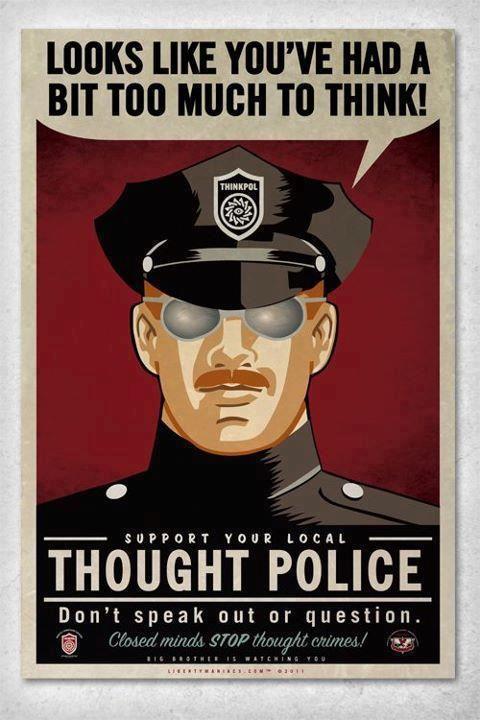
thoughtpolice

To be fair, Harper didn’t come up with the lie of calling Canada a “democracy” (which it’s simply not), or foisting the apparatus of the state to dominate and control. But he, like most other politicians, engages in stately depravity. He knows that after years of screwing over Canada he’ll be rewarded with a fat pension and lots of gifts from his international buddies for things like looking the other way to systemic human rights abuses. “Important Canadian values” my ass.

What about checks and balances?

judgejudy

Oh, you must be referring to the government-appointed juduciary (or a healthy smattering of corrupt, degenerate, ignorant and incompetent Justices of the Peace), or maybe the equally undemocratic Senate, or maybe the innumerable, undemocratic “authorities” that are imposed on us via the shell game of elections and self-appointed power of the moneyed ruling class.

So the term “fascist tyranny” is not a spurious, knee-jerk reaction or a flimsy propaganda label — it’s a sober definition based on overt deeds.

If it quacks like a duck, as they say.

Okay, so you still don’t like “corporate-fascist tyranny”? Too many memories of Nazi Germany? How exactly could Israel and Canada be such close partners given such strong overtones? How indeed, how indeed.

Very well. So if Harper himself called Canada a “dictatorship” and has been working hard to remove that “benign” prefix from the description, what exactly does that make him? And what does that make Canada?

The bad.

The awful arguments of moral relativism — “at least we’re not as bad as _______!” — imply that anything and everything goes as long as our government doesn’t behave like those animals in other countries.

This means that all that needs to happen is for continuing debasement and destruction of those countries (helped along, of course), for the argument to remain valid. They might behead you arbitrarily over there, so it’s okay for us to torture you here. When they get to doing unspeakable things to children, you being merely beaten and imprisoned for having adult opinions is perfectly acceptable … helluva lot better than what they’d do to you.

Price of freedom, buddy.

hicongo-ntaganda

And … AND … terrorism!

Oh yeah…terrorism. Who’s responsible for that again? Surely we need our government to protect us from all those baddies! Okay, so some (unbelievably audacious and fundamentally illegal), abuses might happen, but surely those people will be held to account.

Yeah, surely.

Obviously.

The moral relativist is in most arguments in favour of a race to the bottom, to the very worst crimes and debauchery that humanity can think up — as long as those crimes are slightly better than the other guy’s. The concept of absolute, inhuman control by the fascist state is mirrored in its mindless apologists, along with all the overt lies about your “protection” and “safety” (Terrorism! Crime! Environment! Lefties! Traffic!)

Even if you don’t believe that we’ve arrived at this point, is this what we should be striving for?

Even if you believe that this is merely incompetence, is it logical to depend on the very same people who created and perpetuated these problems for decades/centuries to miraculously fix them?

Okay, I know I’m hammering this topic pretty hard, but only because I absolutely know that the time to take a solid stand is now. The march of corpo-fascism continues across North America and elsewhere, fully promulgated by our “democratically elected” leaders.

All tomorrows are too late.

The good.

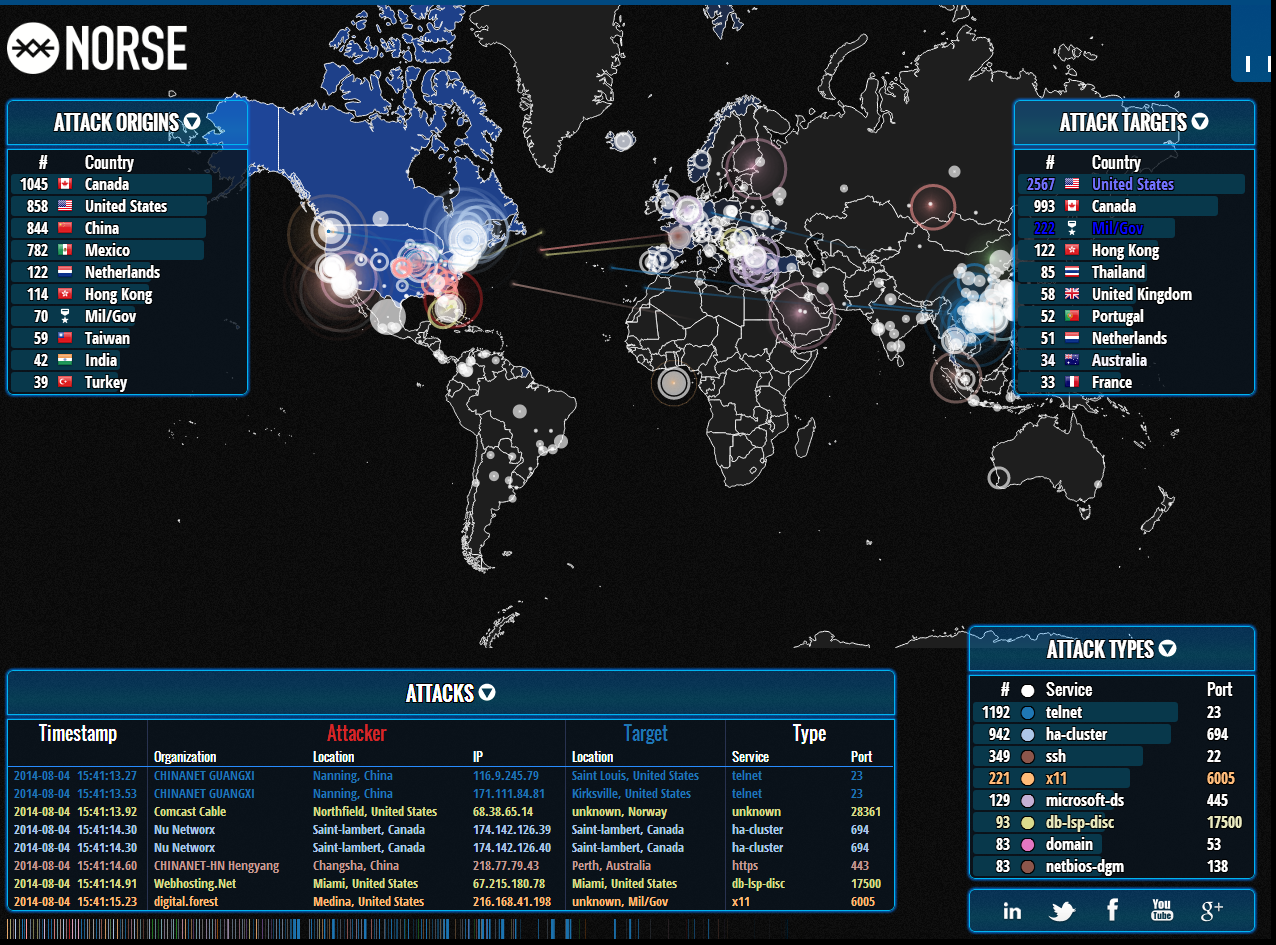
IPViking attack map

The map above is from Norse Corporation’s IPViking Live site where you can see many of the world’s cyber attacks in realtime.

While a map of attacks in the ongoing “cyberwar” (a fear-based buzzword), may seem like utter devastation, it really only shows good old-fashion hack ‘n crack activity with the occasional DDOS attack (nothing more than the target being overwhelmed with too much intentional internet traffic — a very brute-force technique).

In fact, aside from a change in connectivity and some improvements in security, many of the underlying penetration techniques haven’t changed much since I was a pimply-faced, war-dialing teenager.

war_games

What the map reveals, however, is that Canada’s internet connection to the world is still somewhat open and unencumbered (net neutrality not withstanding), which is confirmed by the the renewed attention of the copyright goon squad.

Better still, the increasingly brave belief in privacy and anonymity (and moreover simply basic justice), are alive and well in Canada. It is increasingly Canadians who champion truth, justice, and democracy (in the truest sense), around the world.

Take, for example, Montreal’s Subgraph. They come right out of the gate with a firm declaration:

Subgraph is an open source security company.

This means that we believe that open source means the best possible assurance of security at a time when trust is increasingly challenging.

Subgraph takes its inspiration from the domain of cryptography where proprietary algorithms are never trusted, and extends this principle to software.

If a proprietary algorithm cannot be trusted, why trust proprietary, closed-source security software?

I like where they’re going with this. I also like that they’ve taken on the task of creating Subgraph OS and Mail, a much-needed alternative to Tails which is a fully self-contained operating system built around security, privacy, and anonymity that has recently received some skepticism.

Closer to home we find the University of Toronto’s Citizen Lab, a group dedicated more to threat analysis and neutralization rather than the creation of new products (though they sometimes make those too).

Citizen Lab is lead by Ron Deibert who Sarah informs me often carries himself (and is received as) a rockstar, probably because of stuff like this:

…he was sitting on a panel with John Adams, the former chief of the Communications Security Establishment Canada (CSEC), the National Security Agency’s little-known northern ally. Afterward, he recalls, the former spy chief approached and casually remarked that there were people in government who wanted Deibert arrested—and that he was one of them.

…

It’s a bit freaky to hear that,” Deibert said when he recalled the Calgary encounter in an interview with Ars. “When people ask, ‘are you worried about the Chinese or some other adversary out there,’ I say I’m always a bit more worried about my own government, because this is the kind of thing I hear occasionally.”

It’s Citizen Lab’s razor-edge stride between academic rigour, establishment paranoia, and charisma that make it both a formidable force as well as a model for what I think needs to happen, at least in the online world. Increasingly, I believe that Citizen Lab is an example of the type organization that freedom and truth-minded individuals will come to rely on — a group of enlightened individuals who know what time it is.

flavaflav

If you don’t go for these freewheeling hippie types, there are older and more established schools of thought that underscore this entire line of thinking; schools like the Rothbard Insitute, another academic but considerably stuffier organization espousing individual freedom through “radical” economic ideas, and the Mises Institute which runs along similar lines.

On the political front we find groups like the Pirate Party which, despite the malignancies heaped on the name by the corpo-state, is ultimately for individual rights and freedoms:

To describe the goal of the Pirate Party in a single word, I would use “empowerment”. The beauty of the Internet and information technology is the ability for a poor child to have the same opportunities to create change as a wealthy privileged adult. It is the goal of the Pirate Party to encourage that strength, and to promote values which will empower every Canadian.

And if Rothbard or Mises are too rigid for your enjoyment, there are many bright, well-spoken, informed individuals out there that help to bridge the gaps; everything from applicable advice to thought-provoking witticisms.

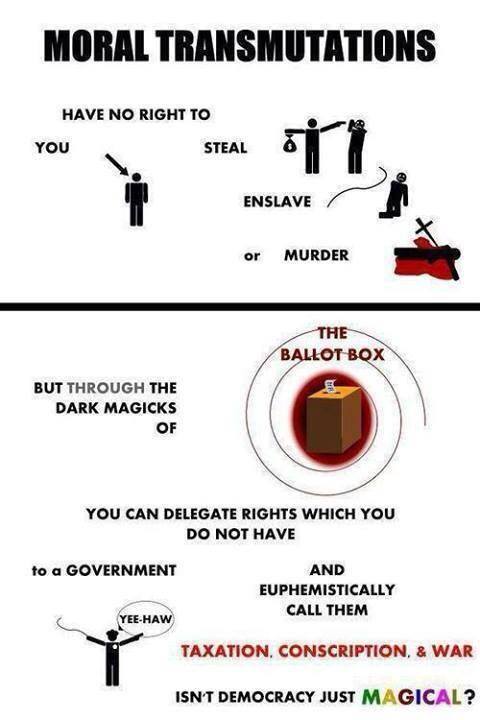
magical democracy

Complacency and continuing acquiescence are, of course, an option. Going along with or supporting the increasingly fascist state are another. We could also worship the flying spaghetti monster, believe that voting makes a difference, trust that government is working for our benefit, etc.

We have some good examples of how such beliefs work out … maybe it’s time for something different this time?

Filed under: B Sides, Patrick Bay, Pictures